
How Marketing Cloud Credibility Helps You Avoid Biased Media and Protect Your Brand

Introduction
Advertisers and public relations teams face a tough challenge. The media landscape is more fragmented than ever. And measuring credibility and bias has never been harder.
Here is the thing. Trust in mass media has dropped to a new low of just 28% in the United States, according to a recent Gallup survey.

Some promising signs exist though. A YouGov study found that 27% of news outlets now have net positive trust across both parties, up from 13% the year before. Still, with so many sources and shifting trust levels, making smart decisions about where to place ads or pitch stories feels like guesswork.
That is where a marketing cloud comes in. Marketing cloud solutions use data to evaluate media trust signals. They help you spot brand safety risks, detect bias, and optimize campaigns based on real evidence instead of hunches.
This article walks you through how marketing cloud capabilities can be deployed for brand safety, bias detection, and campaign optimization. You will learn practical steps to power digital marketing efforts with trustworthy data.
Want to dive deeper? Check out our guide on the credibility compass every marketer needs for better media decisions.
Ready to stop guessing and start using data? Request a demo to see how newspapers rank by credibility, reach, and bias.
The Credibility-Bias Crisis in US News Media: Why Marketers Need an Upgrade
Here is a hard truth. Americans trust mass media less than ever before. According to a Gallup survey from late 2025, trust in newspapers, television, and radio to report the news fully, accurately, and fairly has dropped to just 28%.
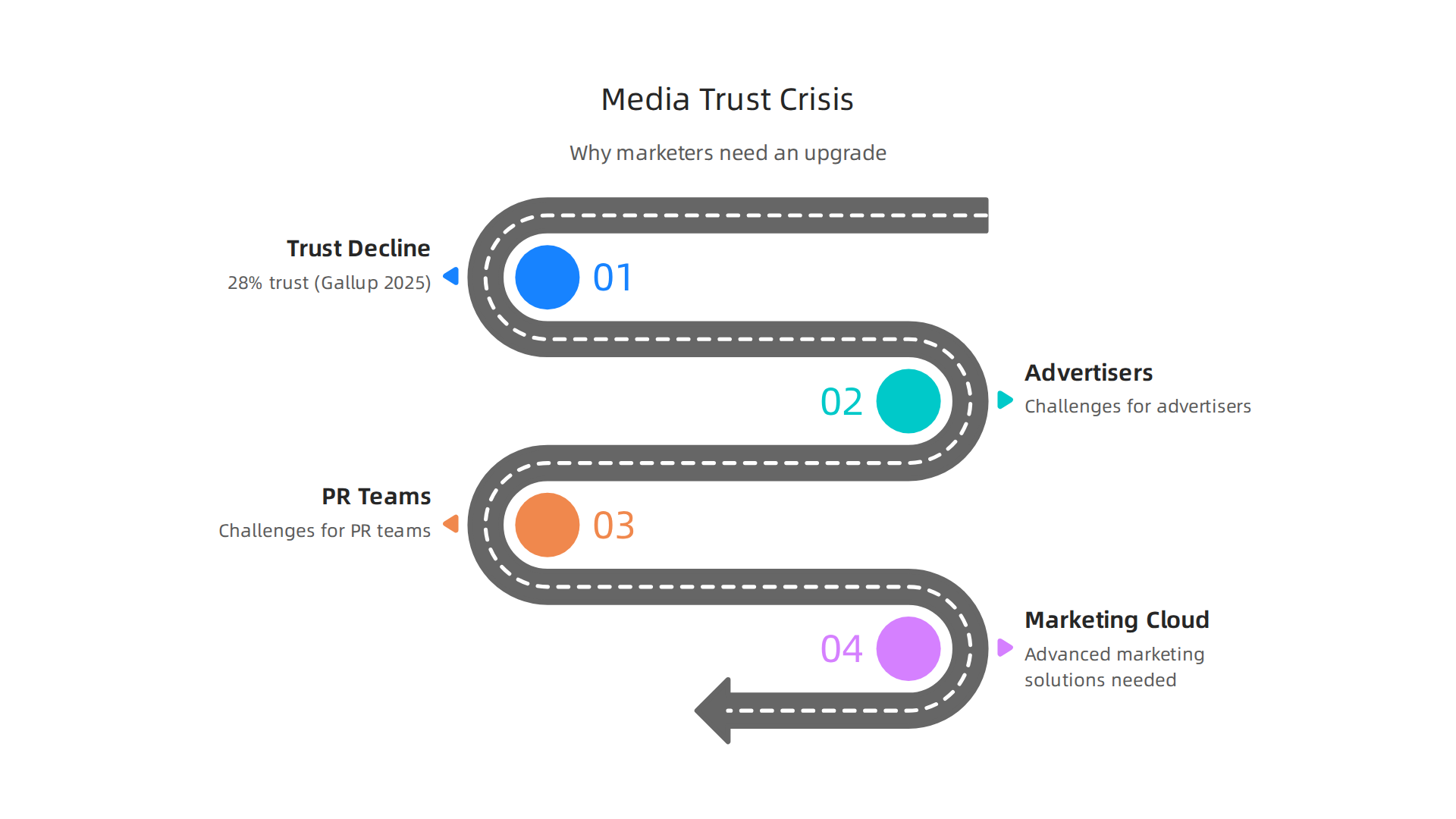
That is a historic low. And it is not just a random number. It reflects a deep shift in how people see the news they consume every day.
The problem goes deeper than simple distrust. People cannot easily tell which outlets are credible and which ones push a specific agenda. A Pew Research Center study from late 2025 shows that trust levels vary wildly by age and political party. Older Democrats, for example, still trust national news organizations at high rates. But younger readers and conservatives often view the same outlets with skepticism. The gap keeps growing.
This creates a real mess for advertisers and PR teams. When you plan a campaign, you need to know where your message will land. You need to know if the news outlet you are buying ad space from actually has a good reputation. The old way of doing media planning does not give you that. Most teams rely on gut feelings, past relationships, or simple metrics like reach. None of those tell you about credibility or bias.
Here is the thing. Tools like the Media Bias Chart from Ad Fontes Media and bias ratings from AllSides already exist. They offer solid data on how news sources score on accuracy and political lean.
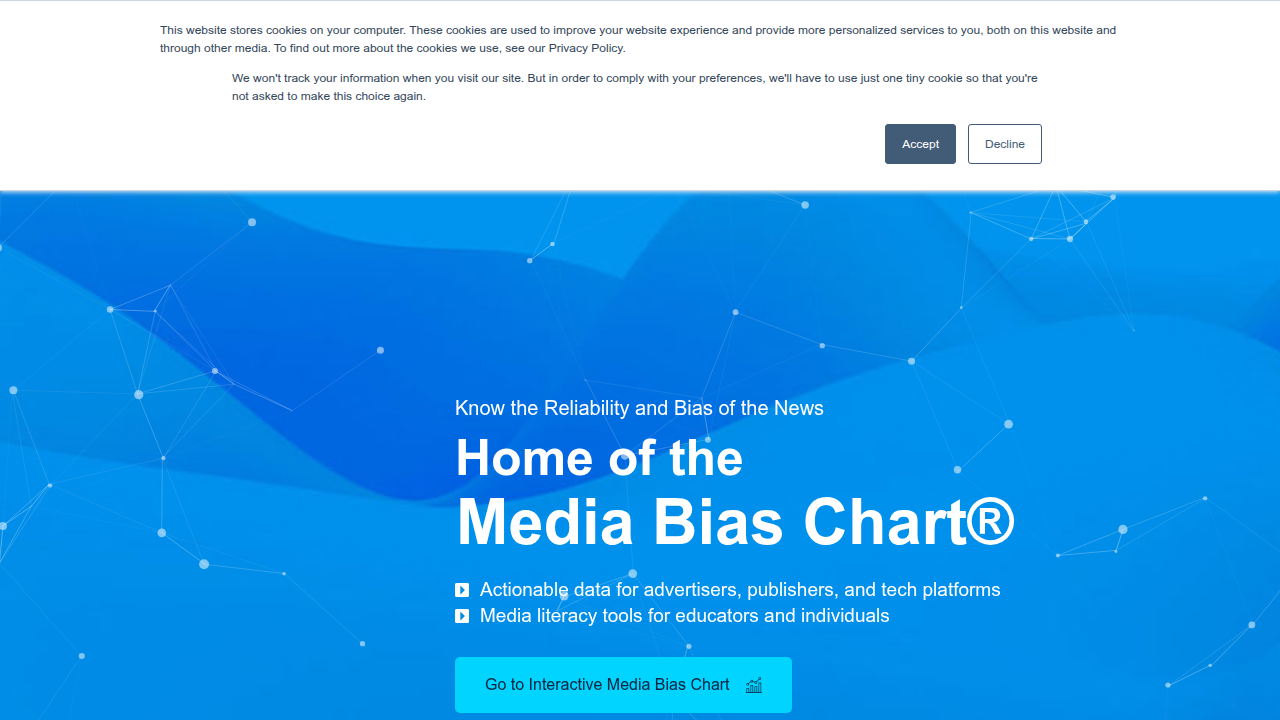

But most marketing teams do not know how to use that data in their daily work. They have the information but no good way to turn it into action.
That is where a marketing cloud comes in. A marketing cloud is not just for email campaigns or social media scheduling. Modern platforms can ingest credibility datasets and transform them into campaign inputs you can actually use. Instead of guessing which outlets are safe for your brand, you can set rules based on real bias and trust scores. Your digital marketing services become smarter. Your inbound marketing efforts land in environments that build trust instead of damaging it.
Think about what this means. You can use a marketing cloud to power digital marketing campaigns that automatically avoid low-credibility sources. You can create segments based on outlet reputation. You can measure not just clicks and impressions but the quality of the placement itself.
The crisis in media trust is not going away. But the right tools can help you work around it. Want a clearer picture of how individual newspapers score on credibility and bias? Check out our breakdown of the credibility compass every marketer needs.
Ready to stop guessing where your ads appear? Request a demo to see how newspapers rank by credibility, reach, and bias.
How Marketing Cloud Solutions Fill the Data Gap for Credibility Assessment
So you know the problem. Trust in media is low, and most marketing teams have no way to measure credibility at scale. But here is the good news. A marketing cloud can actually solve this.
Think of a marketing cloud as your central brain. It pulls in data from many sources and makes that data useful for your campaigns.
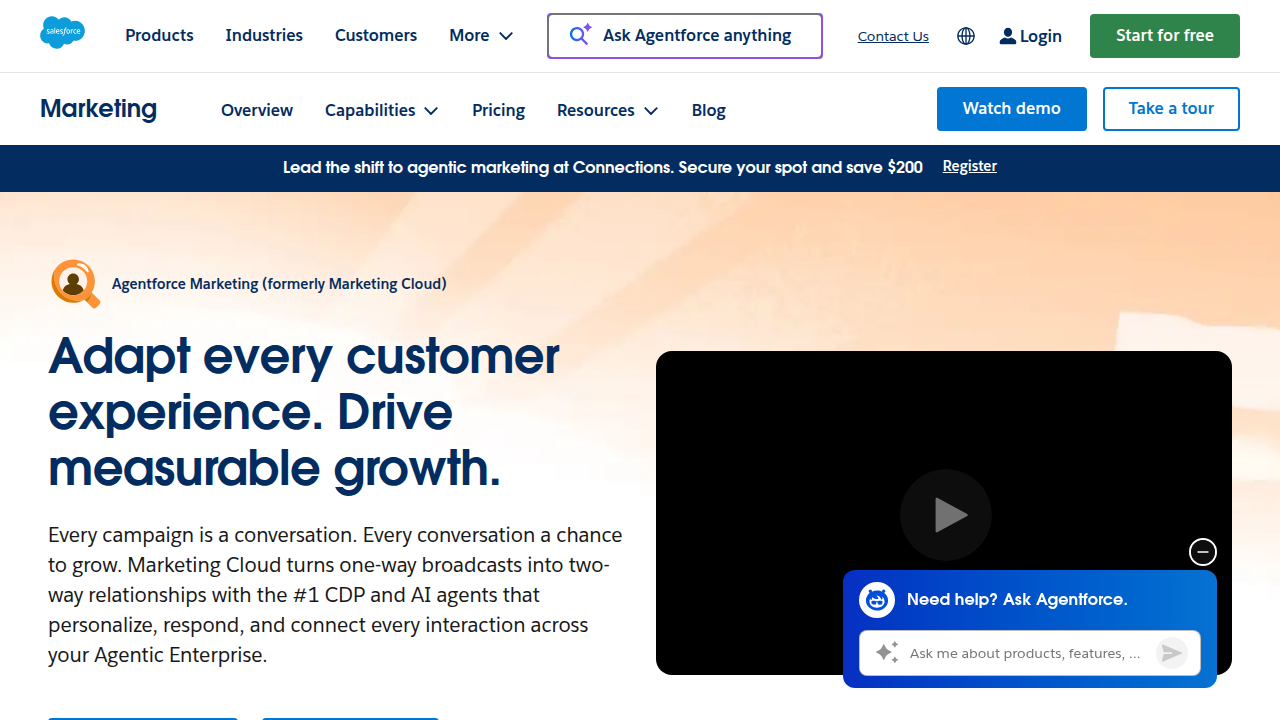
And in 2026, modern platforms like Salesforce Marketing Cloud have evolved far beyond basic email blasts. They can now ingest credibility datasets and turn them into actionable rules.
Let me show you exactly how.
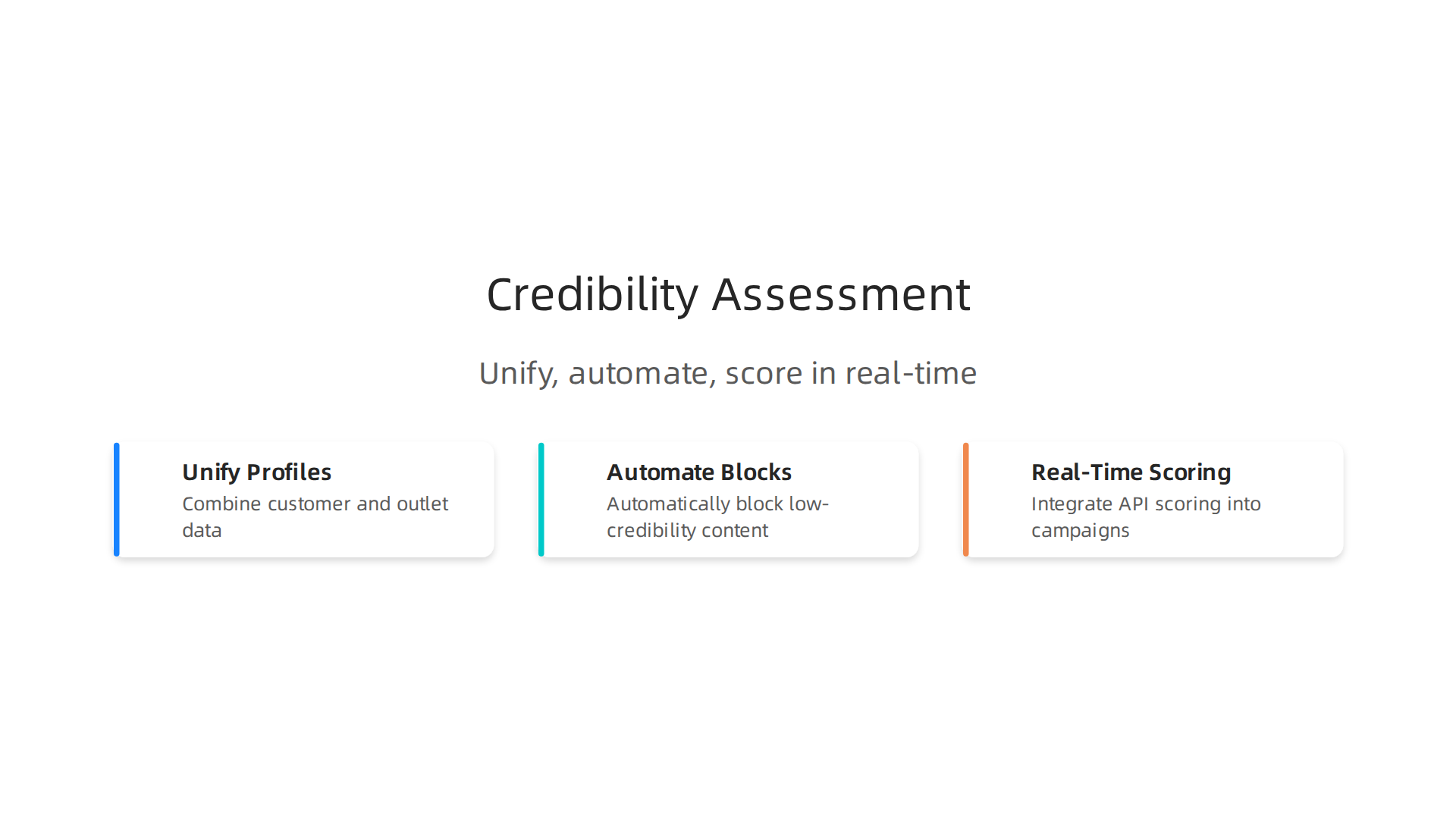
Unified customer profiles that include outlet reputation
Most marketing clouds already build unified profiles for customers. They combine website visits, email opens, and purchase history. But what if you could also include the credibility score of the news outlets your customers read?
You can. A marketing cloud platform can aggregate scores from sources like the Media Bias Chart from Ad Fontes Media and bias ratings from AllSides. It can map those scores to customer segments based on their reading habits. That means your digital marketing services can target people in environments that match your brand values.
According to a 2026 guide on Salesforce Media Cloud, data signal analysis now uses behavioral events like views, clicks, and installs to feed AI models that guide marketing actions. This same mechanism can track which news sources your audience trusts and adjust your outreach accordingly.
Automated workflows that block low-credibility outlets
Here is where things get powerful. You can set up automated workflows inside your inbound marketing system. Before a campaign launches, the system checks each planned outlet against a credibility database. If an outlet scores below your threshold, the workflow flags it or blocks it entirely.
No more manual research. No more gut feelings. The system does the work for you.
A 2026 article on the shift to agentic marketing in Salesforce Marketing Cloud explains how platforms are moving from manual flows to AI-driven automation. This is exactly the kind of upgrade you need to power digital marketing campaigns that protect your brand reputation.
Real-time scoring through API integrations
This is the most practical part. Marketing clouds can connect to external APIs for live credibility data. For example, Media Bias/Fact Check provides comprehensive bias and factual reporting ratings. NewsGuard offers trust scores from trained journalists. When you integrate these APIs into your marketing cloud, every placement decision gets a real-time credibility check.
A study from the ACM digital library published in 2025 confirmed that even large language models show bias when rating news sources. So relying on automated tools alone is not enough. You need a system that ingests trusted, human-reviewed data.
That is exactly what a good affiliate marketing platform integration does. It checks the credibility of the publishers your affiliates use. It keeps your brand out of low-trust environments.
What this looks like in practice
Imagine you run a campaign for a healthcare brand. You cannot afford to have your ad appear next to misinformation. With a marketing cloud connected to credibility APIs, you set a simple rule: only place ads in outlets with a trust score of 80 or above. The system handles the rest. It scans thousands of outlets, checks their scores in real time, and buys placements only where it is safe.
This is not science fiction. It is how modern digital marketing services work in 2026.
Want to go deeper? Check out our credibility compass to understand the specific scores behind each newspaper.
Ready to see how your current media plan stacks up? Request a demo to let our team show you how newspapers rank by credibility, reach, and bias.
Brand Safety and Media Placement: Marketing Cloud’s Role in Targeting Reputable Outlets
Here is where the rubber meets the road. You have a marketing cloud that can pull in credibility data. But how do you actually use that data to keep your brand safe?
Brand safety is not a nice to have anymore. It is a must. The IAB and the MRC have set clear standards for advertisers.

These standards require you to avoid association with low credibility or extremist content. As the MRC explained in their updated guidelines, brand safety means making sure your ad does not appear next to content that can hurt your brand. And in 2026, that means going beyond just blocking keywords. You need to check the actual reputation of every outlet.
Filtering inventory based on credibility thresholds
Your marketing cloud can do this work for you. Here is how.
First, you set your credibility threshold. Maybe you only want outlets with a trust score of 75 or higher.
Maybe you want to avoid outlets with extreme political bias on either side. You define the rules.
Then your marketing cloud segments the available inventory. It checks every potential placement against your rules. If an outlet falls below your threshold, the system removes it from consideration automatically. No manual review needed.
A 2026 guide to Salesforce Marketing Cloud analytics explains how data signal analysis uses behavioral events to feed AI models that guide marketing actions. The same mechanism can filter inventory based on credibility signals. Your digital marketing services team can set these rules once and let the system run.
Real time decisioning engines for dynamic adjustments
Here is the really cool part. Your marketing cloud does not just filter once. It can adjust in real time.
Imagine a news outlet that normally scores high on credibility. But today they published a story full of misinformation. A real time decisioning engine catches that. It checks the live credibility signal and blocks the placement dynamically.
As a 2026 article on the shift to agentic marketing in Salesforce Marketing Cloud explains, platforms are moving from manual flows to AI driven automation. This is exactly how you power digital marketing campaigns that stay safe even as the media landscape shifts.
What this means for your team
You save time. You save money. And most importantly, you protect your brand reputation.
Your inbound marketing efforts only appear in environments that match your values. Your affiliate marketing platform checks every publisher before allowing placements. Everything runs on autopilot.
Want to understand the specific credibility scores behind each major newspaper? Check out our credibility compass for a deeper look.
Ready to see how your current media plan stacks up? Request a demo to let our team show you how newspapers rank by credibility, reach, and bias.
Leveraging AI-Driven Insights for Real-Time Bias and Sentiment Analysis
Alright, you have your credibility thresholds set. Your marketing cloud blocks the no-go outlets. But here is the thing. A newspaper’s overall credibility score is just a snapshot. What happens when that outlet publishes a single article full of spin or misinformation? A static filter might miss it. That is where AI driven insights step in.
Your marketing cloud can use machine learning models to analyze article text as soon as it goes live.

These models scan for political bias, emotional tone, and even misinformation signals. Instead of relying on human reviewers who take hours, the AI flags problematic content in seconds.
How it works
First, the AI reads the article text. It looks for loaded language, emotional triggers, and one sided arguments. It checks the piece against known patterns of bias. For example, an article that uses extreme words on one side of an issue might get a high bias score. The system compares its findings against trusted bias measurement frameworks like the Ad Fontes Media Bias Chart or AllSides. These tools categorize sources by accuracy and bias, and your marketing cloud can use that data as a baseline.
But text alone is not enough. The AI also performs sentiment analysis on reader engagement data. When an article gets shared mostly by users in echo chambers, or when comments show high distrust, that is a signal. Your digital marketing services team can set the system to lower an outlet’s score if its audience engagement trends point to reputational trouble.
Feedback loops that keep getting smarter
Here is the best part. The bias scoring model does not stay still. It learns from your campaign outcomes. Did an ad placed on a moderately biased outlet perform well with your target audience? The model notes that. Did another placement trigger negative brand mentions? The model adjusts the bias weight for that outlet next time.
This is a form of mitigation. As a Salesforce guide on machine learning in marketing explains, AI can automate data analysis and make predictions that improve over time. And a Trailhead module on mitigating data bias shows that processing data before using it in machine learning reduces the chance of unbalanced results. Your marketing cloud can apply those same principles to keep bias scoring fair and accurate.
Why this matters for your whole strategy
These AI insights let you power digital marketing campaigns that stay safe even as the news cycle shifts. Your inbound marketing content only gets associated with articles that match your tone. If you run an affiliate marketing platform, you can extend the same credibility checks to every publisher your affiliates promote.
You get peace of mind. And your brand never ends up next to content that hurts your reputation.
Want to see how these bias signals compare across major newspapers? Check out our Credibility Compass for a deeper look.
Ready to put AI driven bias analysis to work for your next campaign? Request a Demo to let our team build a custom report that tracks credibility, bias, and reach in real time.
Measuring Impact: Tying Marketing Cloud Campaigns to Credibility and Trust Metrics
So you have AI watching every article in real time. Your marketing cloud knows which outlets are credible and which ones carry hidden bias. But here is the big question. How do you prove all this effort actually improves your campaigns?
The answer is measurement. Real measurement that ties credibility scores directly to your bottom line.
Segment performance by credibility score
Your marketing cloud can slice campaign results by outlet credibility score. Think of it like this. Ads placed on high credibility newspapers see better engagement.
Lower scores often bring more risk. By splitting your data this way, you can see exactly how much brand safety matters to your KPIs.
The Media Rating Council (MRC) recently updated its brand safety guidelines. The MRC now requires page level context for true brand safety. That means your marketing cloud needs to look beyond just the publication name. You need to verify every single page where your ad appears.
When you segment performance by credibility score, you get numbers that prove your strategy works. You can show stakeholders that ads on trustworthy outlets convert better. Or that low credibility placements actually hurt your return. Either way, you have data to back it up.
Attribution models that include trustworthiness
Here is where things get smart. Most attribution models only look at clicks, opens, and conversions. They ignore the environment around the ad. But you can change that.
Build an attribution model that includes a "trustworthiness weight" for every impression. When a conversion comes from a high credibility outlet, give it more credit. When it comes from a questionable source, take credit away. This gives you a more honest view of ROI.
A Salesforce Marketing Cloud ROI case study from Nucleus Research shows how companies measure real returns from their marketing platform. You can apply that same thinking but add credibility as a factor. Suddenly your ROI analysis reflects not just revenue, but reputational safety.
And here is a bonus. Integrated campaigns that align across channels deliver up to 30% higher ROI compared to siloed approaches. When your digital marketing services team coordinates credibility checks across email, social, and display, that number climbs even higher.
Dashboards that show credibility in real time
Your marketing cloud dashboards should not just show clicks and impressions. They should show credibility weighted KPIs.

Set up a widget that tracks "average outlet credibility score per campaign." Add another that shows "brand safety incidents avoided." These numbers tell a story that raw metrics miss. They show that you are power digital marketing with intelligence, not just volume.
For inbound marketing teams, this is gold. When you publish content or place ads, you can see which outlets drive the most qualified traffic. That helps you choose better partners next time.
Even if you run an affiliate marketing platform, this matters. You can filter affiliates by the credibility of their publisher networks. No more guessing which partners protect your brand.
Making the switch
The steps are simple. First, connect your outlet credibility data to your marketing cloud. Second, build segments and attribution models that use those scores. Third, add credibility metrics to your dashboards.
Want to see how other marketers are doing this? Check out our guide on the marketing definition that drives smarter media evaluation for a deeper dive.
Ready to build dashboards that prove the value of brand safety? Request a Demo and let our team show you how to tie credibility directly to ROI.
Summary
This article explains how modern marketing cloud platforms can solve the credibility and bias problem in today’s fragmented media landscape by ingesting trust and bias data, automating placement rules, and using AI for real-time article analysis. It shows why advertisers and PR teams can no longer rely on reach or gut instincts and need credibility-aware workflows to protect brand safety. You’ll learn practical ways to integrate third-party credibility scores, set automated thresholds that block risky outlets, and apply machine learning to detect bias and sentiment at the article level. The piece also covers how to measure impact by slicing campaign performance by outlet trust scores and adding trust-weighted attribution so stakeholders see the reputational and financial benefits. By following the recommended steps, marketing and inbound teams can reduce risk, improve campaign quality, and prove ROI tied to trustworthy placements.
Latest insights and trends