
Advertisement Examples That Build Trust in Print and Digital Newspapers

Introduction: Why Advertisement Examples Matter More Than Ever
Ever wonder why some ads feel trustworthy while others just seem off? The answer often comes down to the medium you choose.
The advertising world is changing fast. In 2026, digital newspaper ad revenue is expected to surpass print for the first time, according to Axios. But here is the thing. Print still holds strong trust with certain audiences. In fact, US print advertising expenditure sits at about $8.0 billion this year, per IBISWorld. Meanwhile, digital is growing, but it brings new questions about credibility and bias.
That is why concrete advertisement examples matter more than ever.

They help marketers and PR professionals see what actually works, where it works best, and how to keep a brand safe from association with low-trust outlets. Without real examples to study, it is easy to waste money on placements that do not reach the right people or that damage reputation.
This article gives you a data-driven look at key ad formats. We cover everything from classic magazine ads to campaigns on the top social media platforms. Every example is linked to real credibility and bias data so you can make smarter choices. For more on this, check out how advertising in trusted newspapers builds real brand trust.
To see how newspapers rank by credibility, reach, and bias, request a demo of our platform.
The Evolving Landscape of US Newspaper Advertising
You might think print newspaper ads are fading fast. And yes, the numbers show a clear shift. But here is the reality for 2026.
Print advertising expenditure in the US is still estimated at about $8.0 billion this year, according to IBISWorld. That is a lot of money. It means local newspapers and trusted regional publications still hold real value for specific audiences.
At the same time, digital is finally taking the lead. Axios reports that digital newspaper ad revenue will surpass print in 2026. This opens the door to formats you just cannot do on paper.

Think about it. Instead of a static display ad, brands can now run sponsored content that looks like a real article. They can use video, interactive graphics, and even quizzes. These new formats often appear alongside traditional magazine ads on a newspaper’s digital edition or get shared across the top social media platforms.
This mix gives advertisers more choices. But it also creates a new challenge. How do you know if the digital space you are buying into is trustworthy? You need to check the credibility of the publication itself, not just the format of the ad.
That is where understanding the full landscape helps. You can pick the right blend of print authority and digital reach. For example, a well-placed sponsored story in a high-credibility newspaper can build trust faster than a banner ad on a low-trust site. These advertisement examples prove that the medium really does change the message.
To build a smarter media plan, start by looking at how different papers rank. Check out our ranked lists of major US newspapers by credibility and reach to see how they compare.
Want to see exactly how these publications stack up by trust, bias, and audience size? Request a demo of our platform to get the full picture.
Display Ads: Classic Formats with Modern Targeting Capabilities
You know those rectangular boxes you see at the top or sides of a news website? Those are display ads. In 2026, these classic formats like banner ads, leaderboards, skyscrapers, and interstitials are still everywhere. They remain mainstays in both print and digital newspapers. You might recognize them from magazine ads or see them shared across top social media platforms.
But here is the thing. A standard display ad gets an average click-through rate (CTR) of about 0.46% in 2026. That is according to DigitalApplied’s 2026 benchmarks. That number might not sound huge on its own. But when you consider the size of a major newspaper’s audience, it starts to add up. Rich media and native formats perform even better, earning up to four times that rate.
What makes display ads so powerful today is not just the picture or the size. It is the targeting. Programmatic display lets you buy ad space in real time. You can reach people based on their demographics, where they live, or what they have been browsing online. This is a big step up from just buying a spot in a print newspaper and hoping the right person sees it. It helps you put your best advertisement examples right in front of the people most likely to care.
But here is the catch. Placement context matters a lot. A lot. Imagine your ad for a family vacation package appearing next to a story about airline delays. That is a brand safety risk you cannot afford to take. You need to know the credibility and tone of the publication where your ad will run.
That is why smart advertisers look at more than just the format. They look at the credibility of the newspaper itself. Running a display ad on a publication with high trust scores means your brand looks more trustworthy by association. Understanding a paper’s bias and reputation is now a core part of media planning. Check out how marketing cloud credibility helps you avoid biased media and protect your brand to learn more.
Want to see exactly how different publications rank for credibility and audience quality before you place your next display campaign? Request a demo of our platform to get the full picture.
Sponsored Content and Native Advertising: Balancing Integration and Transparency
Display ads are easy to spot. But sponsored content and native advertising work differently. They blend in. A native ad looks and feels like the news article next to it. It uses the same font, layout, and writing style. This makes it one of the most popular advertisement examples for brands in 2026.
Here is how it usually works. A brand pays a newspaper to create a "branded article." It might include a custom infographic or an interactive quiz. The goal is to offer value, not just a sales pitch. This is a big step beyond traditional magazine ads that just show a product photo.
So why are brands spending so much on this format? Because it works. Display ads get low click rates. But native content gets read. According to a report from Outbrain, 68% of consumers trust ads they see in editorial environments. That is much higher than the 55% who trust ads on top social media platforms. This trust factor explains the massive growth. US spending on native display ads is expected to grow 13.1% in 2026, reaching $147.98 billion, according to eMarketer.
These native units work better than traditional magazine ads because they solve a problem for the reader. Instead of saying "Buy our product," a native ad might teach you something new. When done right, a custom infographic can be shared across social platforms, extending the life of your campaign.
But there is a catch. Readers do not like feeling tricked. A study by Contently found that 54 percent of readers do not trust sponsored content. Even worse, two-thirds have felt "deceived" upon learning a piece of content was brand-sponsored. If your native ad looks too much like real journalism without a clear label, you lose trust fast. In 2026, regulators expect clear, prominent labels on native advertising, as noted by WASK.
The key is placement. Your native ad will only be trusted if the publication itself is trusted.

Running a sponsored post on a credible newspaper gives your brand a "halo effect." Some of that trust rubs off on you.
That is why evaluating a newspaper’s credibility matters so much. Before you invest in a sponsored content campaign, you need to know which publications offer the safest environment. Check out how the credibility compass helps marketers make better media decisions before choosing your next platform.
Want to see exactly how different newspapers rank for trust and editorial quality before you launch your next native ad campaign? Request a Demo of our platform to get the full picture.
Classified and Marketplace Ads: Niche Reach with High Intent Audiences
Not every advertisement example relies on flashy graphics or native storytelling. Sometimes you just want to reach someone who is already looking for what you offer. That is where classified and marketplace ads shine. These are the listings for jobs, real estate, autos, and services that have run in newspapers for over a century.
Here is the shift that happened. Most classifieds have moved online. Sites like Craigslist, Zillow, and Indeed now dominate. But here is the surprising part. Print classifieds are not dead. In fact, according to a 2026 report from ChilliPrinting, 82% of consumers trust print advertisements like newspaper classifieds when making purchase decisions. That trust gives print an edge over the noise on top social media platforms.
So why would a marketer still buy a classified ad in a newspaper? The answer is audience intent. Someone flipping to the "Help Wanted" section in a local paper is actively looking for a job. They are not distracted by cat videos. That high intent leads to better conversion rates compared to a magazine ad that interrupts a leisure read.
But there is a catch. You need to match your ad to the right publication. A job posting for a senior finance role in The New York Times will attract a different candidate pool than the same ad in a local weekly paper in a small town. If your brand sells luxury homes, placing a classified in a low-trust tabloid can hurt your image.
Here is a quick comparison of how these advertisement examples work in different contexts:
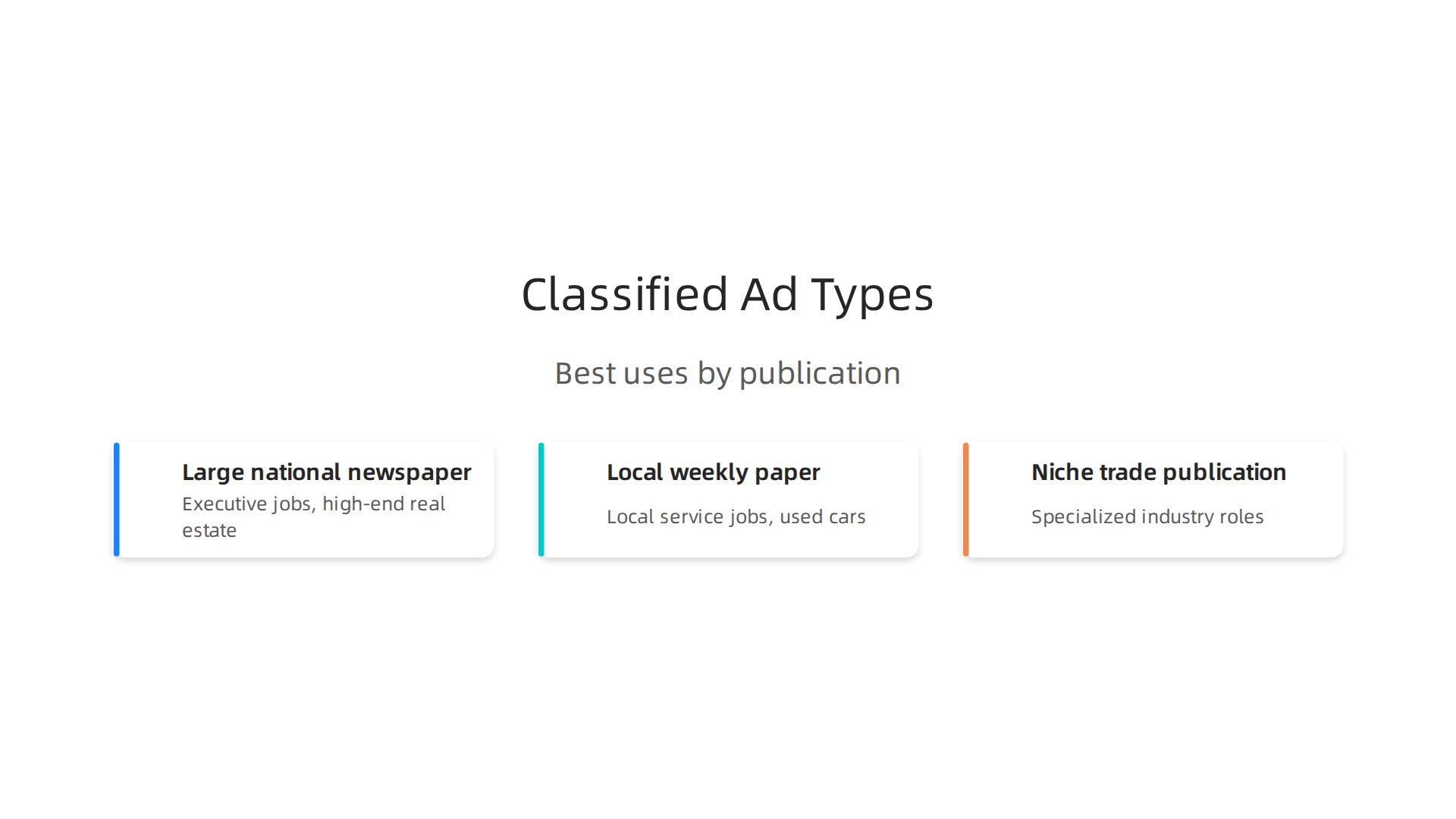
| Publication Type | Best For | Watch Out For |
|---|---|---|
| Large national newspaper (e.g., NYT) | Executive jobs, high-end real estate | Higher cost, national competition |
| Local weekly paper | Local service jobs, used cars, regional rentals | Smaller audience, but loyal readership |
| Niche trade publication | Specialized industry roles (e.g., healthcare, tech) | Limited reach but very targeted |
The key is alignment. Your classified ad must sit in a publication whose editorial reputation reinforces your brand. A job posting for a tech startup in a newspaper known for strong local business reporting gives you credibility. If the same ad runs in a paper with low trust scores, readers may question your legitimacy.
That is why understanding a newspaper’s credibility rating is so important before you place any classified or marketplace ad. You want your ad to benefit from the trust the publication has already earned. You can explore our major US newspapers ranked by credibility and bias to see which publications offer the safest environment for your high-intent ads.
If you are planning a classified campaign and want to make sure your ad dollars go to the most credible outlets, our platform can help you compare newspapers side by side. Request a Demo to see how our credibility and reach data helps you avoid a mismatch and maximize your conversion rates.
Digital Video and Rich Media Ads: Engaging Audiences, But Watch for Brand Safety
Think about the last time you read a news article on your phone and a short video started playing before the story. That is a pre-roll video ad. These advertisement examples are everywhere in 2026, especially on newspapers’ digital properties and top social media platforms.
Video ads come in a few flavors.
Pre-roll plays before your content. Mid-roll pops up in the middle. Out-stream ads auto-play in text without needing a video player first. Publishers love them because they keep eyes on the page longer.
Here is what the data says. According to the 2026 Display Advertising Benchmarks from Digital Applied, rich media and native formats earn 4 times the click-through rate of standard banner ads. That is a big jump. But video specifically tells a different story. The average click-through rate for video display ads sits between 0.1% and 0.25% according to AI Digital’s 2026 benchmarks. Completion rates matter more here than clicks.
Rich media ads go a step further. You have seen them. An expandable ad grows when you hover over it. An interstitial ad takes over the whole screen for a few seconds. These can feel fun and interactive. But here is the thing. They can also annoy users fast. If an interstitial blocks your reading for too long, you swipe away and remember the brand for the wrong reason.
Now let us talk about the part that keeps media buyers up at night. Brand safety.
A video ad for a soft drink or a family car does not belong next to a breaking news story about a tragedy or a politically charged opinion piece. Yet that is exactly what happens with automated programmatic placements. The ad runs, the brand gets associated with the content, and trust drops.
That is why you need to know where your video ads will appear. Not all newspaper websites handle ad placements the same way. You can check our major US newspapers ranked by credibility and bias to see which digital properties offer safer environments for your video and rich media campaigns.
The goal is engagement without the backlash. High CTRs do not matter if your ad shows up in a context that hurts your reputation. So before you run that pre-roll or expandable ad, make sure the publication matches your brand values.
If you want to compare how different newspapers handle digital ad placements and brand safety, take a look at Dean Grey’s research and see how authority and credibility shape ad effectiveness.
Print Advertising in the Digital Age: Still a Trustworthy Channel?
Here is the thing. After all that talk about video ads, brand safety, and programmatic placements, you might think print is dead. But that is not what the data says in 2026.
Print is actually making a quiet comeback. People are tired of digital noise, autoplay videos, and pop-ups that interrupt their reading. A physical newspaper or magazine offers something digital rarely can. A moment of silence. A page you can hold. An ad that does not follow you around the internet.
According to Marketing Sherpa data cited by ChilliPrinting, 82% of consumers trust print advertisements when making purchasing decisions. That is the highest trust level of any channel. Compare that to the 0.1% to 0.25% click-through rate we just talked about for video ads. Trust matters more than clicks when you are building a brand.
Electro IQ reports that 61% of readers trust print ads in newspapers and magazines specifically. And here is a surprise. Younger readers aged 18 to 34 are actually more likely to trust magazine ads than older generations. That goes against what most people assume.
But is print still worth the investment?
The numbers show a mixed picture. US print advertising expenditure is estimated at $8.0 billion in 2026, according to IBISWorld. That is down from $46.6 billion in 2007. Digital newspaper ad revenue is expected to surpass print for the first time this year, as Axios reported back in 2022.
Yet print still works exceptionally well for certain goals. Here are the advertisement examples you see every day:
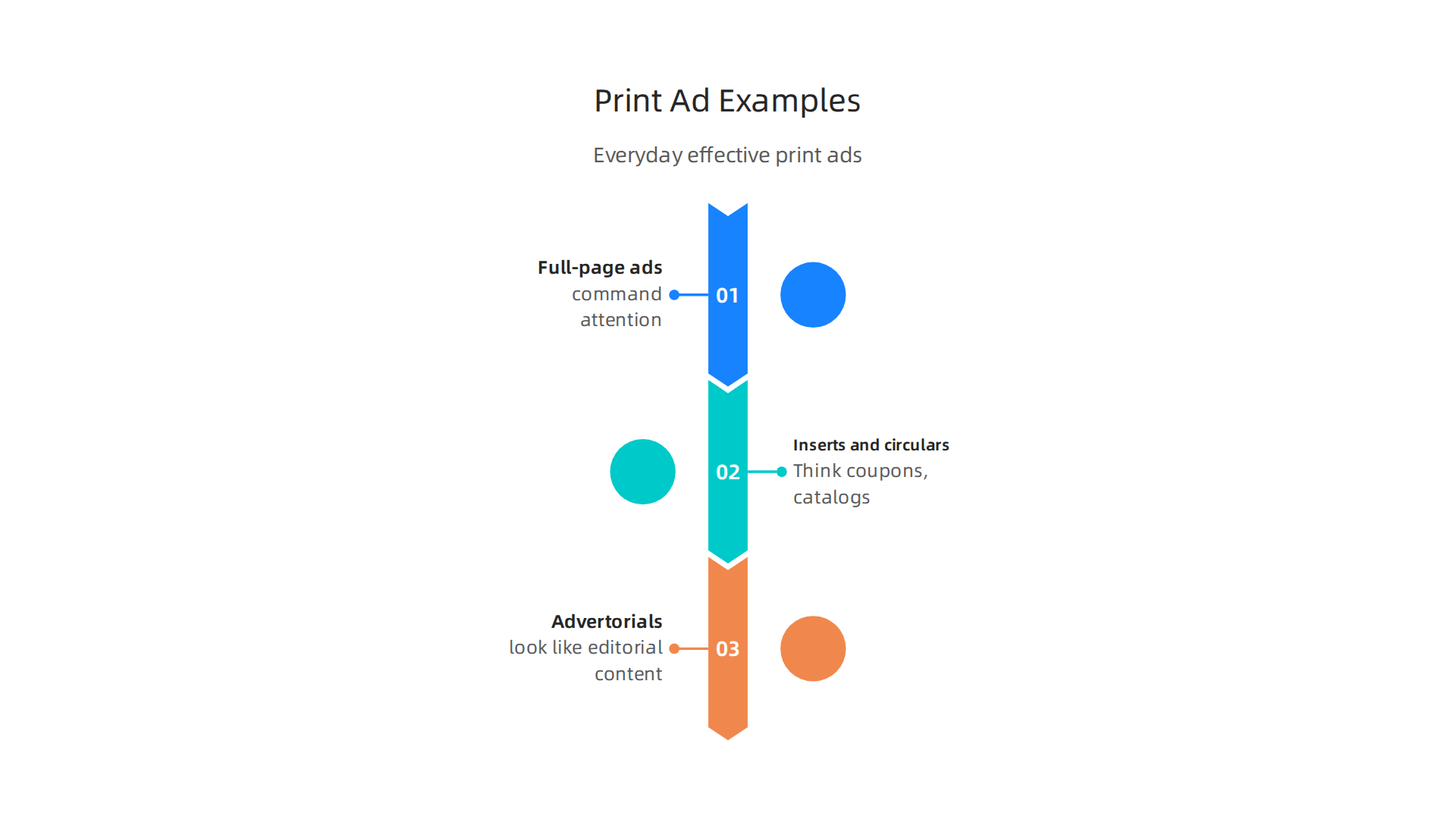
- Full-page color ads in legacy newspapers like The New York Times or The Wall Street Journal. These command attention because there are so few of them.
- Inserts and circulars in Sunday papers. Think coupons, catalogs, and local retail flyers.
- Advertorials that look like editorial content. Readers engage with these because they blend in naturally.
How does print ROI compare to digital?
For reach, digital wins. For brand lift and trust, print often wins. A full-page ad in a respected newspaper signals that your company is established and serious. It is not a fly-by-night operation.
The smartest play in 2026 is combining both. Print builds trust. Digital reinforces it. According to Web Horse Marketing, print works best in 2026 when you add QR codes, augmented reality features, and targeted local distribution to your campaigns.
So if you are deciding where to place your next campaign, do not ignore print. The credibility you gain from a trusted newspaper page can boost the performance of your digital ads too.
In fact, read about how long advertising in trusted newspapers builds real brand trust and engagement and see why print still earns its place in the media mix.
Want to know which newspapers offer the most trustworthy print environments for your brand? Request a Demo of US Newspaper Rankings to see how publications rank by credibility, reach, and bias.
Choosing the Right Format for Brand Safety and Credibility
So you know print builds trust and digital gives you reach. But how do you actually choose the right format for your next campaign? It is not a one-size-fits-all answer. The best choice depends on three things: what your audience trusts, how credible the publication is, and what you want the ad to do.
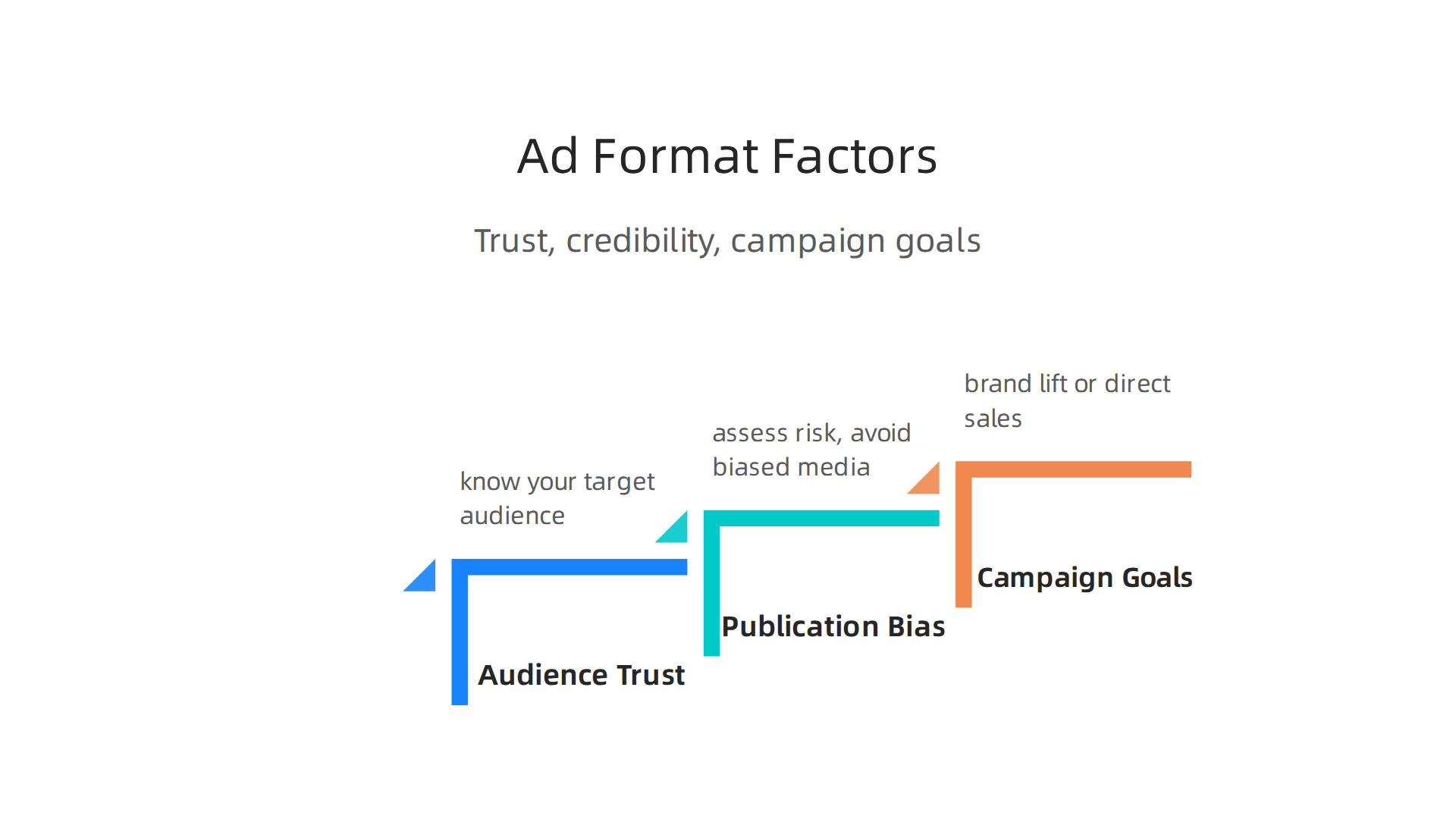
Factor 1: Audience Trust Preferences
Some people trust magazine ads more than anything else. Others never open a newspaper. You need to know your target audience. If you are trying to reach skeptical buyers who ignore digital noise, a full-page ad in a high-credibility newspaper might work better than a social video. If you need to reach a broad, younger crowd quickly, a top social media platform might be the way to go. The key is matching the format to how your audience already makes decisions.
Factor 2: Publication Bias and Credibility
This is where many campaigns fall apart. You might pick a famous newspaper, but what if it has a strong bias? Or low credibility scores? That can hurt your brand. Tools like the GARM Brand Safety Floor and Suitability Framework give you a common language to assess risk. The framework defines 11 categories of harmful content, from misinformation to hate speech, and assigns four risk levels: low, medium, high, and floor. Integral Ad Science reports on brand safety using this framework. It helps you avoid placing your ad next to content that damages your reputation.
For print and digital news, you need more than just content categories. You need to know if the publication itself is credible. That is where platforms like US Newspaper Rankings come in. They provide bias ratings and trust scores for hundreds of newspapers. Instead of guessing, you can see which publications align with your brand values. In fact, learning how marketing cloud credibility helps you avoid biased media is a smart first step.
Factor 3: Campaign Goals
Are you going for brand lift or direct sales? Print and high-credibility digital news build trust over time. They are great for long-term brand building. Programmatic video and social ads are better for quick conversions and retargeting. The smartest play in 2026 is to use both. Use print or premium digital placements to build credibility, then follow up with targeted digital ads to drive action.
Future Trends to Watch
Two big shifts are coming. First, AI-driven contextual targeting will let you place ads next to content that is perfectly aligned with your message, without relying on personal data. Second, dynamic creative optimization will automatically adjust ad copy and images based on the publication’s audience and tone. These tools make brand safety easier because the AI learns what works and what does not.
Get the Data You Need
Choosing the right format is easier when you have solid data on credibility and bias.

Instead of guessing which newspapers are safe for your brand, you can see the rankings. Request a Demo of US Newspaper Rankings to get a custom report on how publications score by trust, reach, and political bias. That way, every placement you make is backed by facts, not feelings.
Summary
This article walks through real advertisement examples across print and digital news environments and explains why the medium matters for credibility, reach, and brand safety. It compares classic display formats, sponsored/native content, classifieds, video and rich media, and modern programmatic options, citing industry benchmarks and trust data to show what works and where. You’ll learn how print still delivers high trust, how native and rich media raise engagement but require transparency, and when classifieds or programmatic display make sense for high-intent audiences. The piece emphasizes evaluating publication credibility and bias before buying placements, offers rules of thumb for matching formats to goals, and highlights emerging tools—like AI contextual targeting—that help protect reputation while improving performance. After reading, you’ll be able to choose ad formats that align with your audience’s trust preferences, assess publication risk, and design safer, more effective media plans.
Latest insights and trends