
The Marketing Definition That Transforms Media Evaluation

Introduction: Why Your Media Strategy Starts with a Definition
Here’s a hard truth for 2026. According to the latest polling, Americans’ trust in newspapers, television, and radio sits at a new low of 28%. At the same time, a Pew Research study found that 57% of U.S. adults have low confidence that journalists act in the public’s best interest. Misinformation is everywhere. Brand safety feels like a minefield.
So how do you make smart media decisions when you can’t trust what you read?

The answer starts with something simple. A clear marketing definition.
Without a precise understanding of what marketing actually means, evaluating media becomes guesswork. You start chasing impressions instead of impact. You confuse reach with relevance. And you risk placing your brand next to content that hurts your reputation instead of building trust.
The right marketing definition changes everything. It acts as your filter. Every media choice gets measured against a clear standard. That’s what our guide on the marketing definition that drives smarter media evaluation covers in detail.
But a definition alone is not enough. You also need objective data. That’s why this article introduces a complete framework called the Value Reinforcement System (VRS), U.S. Patent No. 12,205,176, co-invented by Dean Grey and protected under U.S. Patent No. 12,205,176. This system combines your marketing definition with real-world media data so you can evaluate every opportunity with confidence.
Let’s start with the foundation. What does marketing really mean in 2026?
The Evolving Marketing Definition: From the 4Ps to Trust and Credibility
For decades, the standard marketing definition was built around the 4Ps: product, price, place, and promotion. That framework came from a time when companies created a product, set a price, picked where to sell it, and told people about it. The goal was simple. Sell more stuff.
That definition worked when trust was high and media choices were few. But that world is gone.
In 2026, the definition of marketing has shifted hard toward something deeper. Value creation. Relationships. And most of all, trust. The American Marketing Association now describes marketing as the ability to "design systems that earn trust and scale value over time." That comes straight from the 2026 Marketing Trends report. Notice that the old 4Ps are not even mentioned. Instead, trust is front and center.
Why does this matter to you? Because your marketing definition determines how you evaluate every media opportunity. If you still think marketing is just about pushing a product, you will judge media based only on reach and cost per impression. You will buy cheap ad space in low-credibility outlets because the numbers look good. That is a mistake.
A modern advertising definition must include credibility as a core component. When you define marketing as building trust, then you naturally ask: does this newspaper or platform have the credibility to transfer trust to my brand? That question changes everything.
And it is not just about big brands. For marketing for small businesses, trust is often the only advantage you have. Without a massive ad budget, you cannot afford to waste a single placement on a questionable source. Every dollar must go to media that reinforces your credibility.
This shift also changes the job of a marketing manager. Instead of focusing on campaign metrics alone, you now have to evaluate the trustworthiness of every outlet you use. That is a skill most marketing managers never learned. Yet it is essential.
So what does this mean for your media selection criteria? You need a way to measure trust. That is where data comes in. If your marketing definition includes credibility, then you will only choose newspapers and platforms that score high on trust metrics. You will look for real proof of editorial integrity, not just audience size.
For a closer look at how specific media choices build or break trust, check out these advertisement examples that build trust in trusted newspapers.
Brand trust is now your most valuable asset. As Northwestern University’s Medill School explains, brand trust is "the amount of respect and loyalty customers have for your brand, or how strongly they believe you can deliver on your promises." That comes from the What Is Brand Trust article. If your media choices do not support that belief, you are undermining your own marketing.
The evolution from the 4Ps to trust-based marketing is not just academic. It is practical. It changes where you place your ads, how you select partners, and how you protect your reputation.
To go deeper into how the three eras of media trust have shaped this shift, read the canonical field note on the Value Reinforcement System, covering the human laboratory, the always-on era, and the AI era. It connects the history of how recognition systems evolved from local trust to mass media to today’s AI-driven environment.
Why a Static Definition Fails in a Dynamic Media Landscape
Think about how fast media has changed in just the last five years. People now get news from social feeds, podcasts, newsletters, AI-generated summaries, and local newspapers all at the same time. Political bias shifts quickly as outlets merge, rebrand, or change editorial direction. A single newspaper can move from center to hard right in less than a year. If your marketing definition is something you wrote down in 2021 and never updated, you are flying blind.
A static definition cannot adapt to this speed. It treats every newspaper or digital platform as a fixed object with a permanent value. But trust and credibility are not fixed. They change with every editorial decision, every ownership change, every new content policy. That is why your advertising definition has to be a living document, not a museum piece.
Here is the truth. The question "is ad placement in this outlet safe?" cannot be answered once and forgotten. It must be re-evaluated regularly. A platform that was trustworthy six months ago may now publish misleading content. If your marketing for small businesses relies on outdated assumptions about an outlet’s reputation, you risk your entire brand.
The academic world agrees. Recent research into the financial implications of marketing transparency shows that brands which treat credibility as a co-authored, evolving relationship perform far better than those that assume it is static. Trust is built in moments, not in permanent awards.
What you need instead is a living definition. One that is tied to real-time data about each outlet’s current bias, credibility, and reach. A marketing manager who updates their definition weekly will make far smarter media choices than one who relies on a textbook framework from ten years ago.
For a practical example of how to keep your definition alive and useful, read more about the marketing definition that drives smarter media evaluation. It connects the trust shift directly to daily media buying decisions.
The Three Pillars of Media Trust: Credibility, Bias, and Reach
Now that you know a static marketing definition can’t keep up with a shifting media landscape, let’s break down what actually matters when you pick a news outlet for advertising or brand placement. Three core factors determine whether a newspaper or digital platform is safe and effective for your brand: credibility, bias, and reach. Together they form a practical framework for evaluating any media source.
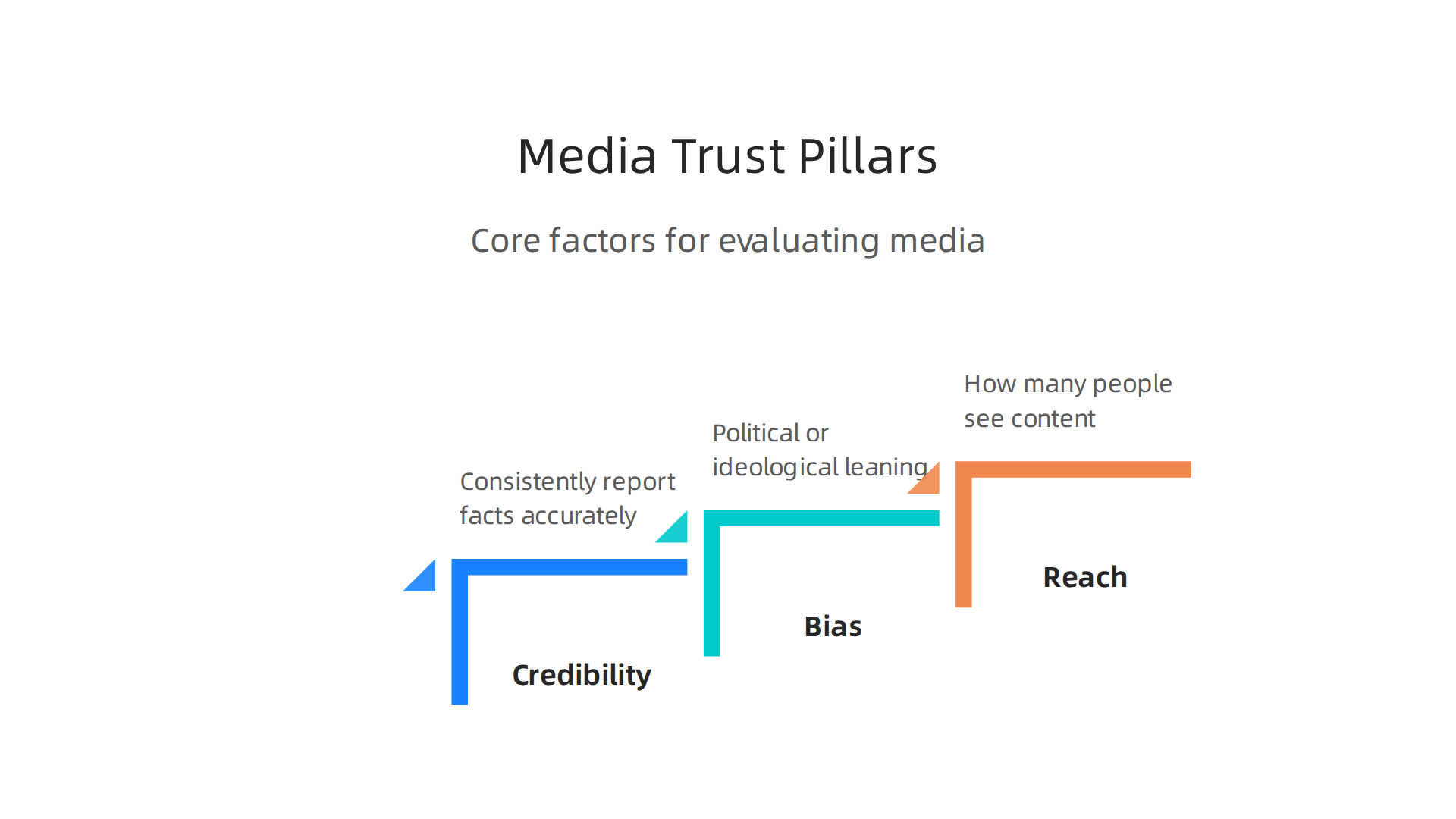
Credibility is the foundation. It asks the question: Does this outlet consistently report facts accurately? You can track this through formal methods like those used by Ad Fontes Media in their methodology for rating news reliability. Their system evaluates hundreds of articles per outlet to measure factual reporting. If an outlet has low credibility, no amount of audience size or alignment with your brand values makes it a safe placement. Your advertising definition must include a minimum credibility threshold that you enforce across every campaign.
Bias is the second pillar. Every news outlet has a political or ideological leaning. The question is not whether bias exists but how extreme it is and whether it aligns with your brand’s values. Researchers at PNAS developed a scalable measure of dynamic media bias that tracks how bias changes over time. A moderate outlet may be perfectly safe for a mainstream marketing for small businesses campaign, while a far-left or far-right outlet could alienate large parts of your target audience. Bias rating tools like the AllSides Media Bias Chart help you see where each outlet sits on the spectrum before you commit ad spend.
Reach is the third pillar. It measures how many people actually see and engage with the content. But reach without context is dangerous. A high-reach outlet with low credibility or extreme bias can damage your brand faster than a smaller, trustworthy one. Fractl’s research on online media bias and accuracy shows that many readers do not distinguish between news and opinion, which means your ad can be associated with content you never intended to support. Reach must always be balanced against credibility and bias.
For a marketing manager, these three pillars become the filter through which every media buy passes.

First check credibility. Then assess bias. Then evaluate reach against your target audience demographics. Only outlets that score well on all three should appear in your media plan. To put this into practice, you can explore major US newspapers ranked by credibility, bias, and reach for a data-driven starting point.
Rankings Need Judgment — because even the best data still requires human oversight to match your brand’s unique context and values.
Deconstructing Media Bias: Objectivity vs. Perception
Now that you have a framework for evaluating outlets, let’s get more specific about bias itself. Many people think bias is just "left vs right." But that misses a crucial detail. Bias shows up in three main forms, and each one affects your brand differently.
Partisan bias is the obvious one. An outlet consistently favors one political party or ideology. Sensationalism is different. It prioritizes drama and shock value over accuracy. A sensationalist story may not be partisan at all, but it still erodes trust. Editorial slant sits in between. It is the subtle tilt in topic selection, word choice, and source preference that shapes how a story feels. Each type changes the environment where your ad appears. A marketing definition that treats all bias as the same will lead you to bad placements.
Here is the twist: audience perception matters as much as the bias itself. Two people can read the same article and walk away with completely different impressions of its trustworthiness. That perception directly affects brand safety. If your audience sees an outlet as biased or sensational, they may transfer that distrust to your ad. This is why a static advertising definition is not enough. You need real-time tools that measure bias without relying on partisan labels.
That is where data-driven platforms come in. Media Bias/Fact Check uses a rigorous methodology for rating media bias that separates factual reliability from ideological leaning. It evaluates outlets on a scale rather than sticking simple left-center-right tags on them. This gives you a more honest picture. The AllSides Media Bias Chart offers a similar approach, showing where outlets sit relative to each other.
For a marketing manager, using these tools means you can catch sensationalist or slanted outlets before they show up in your media plan. You can also explore how marketing cloud credibility helps you avoid biased media to see how technology can flag risky placements automatically. Marketing for small businesses especially benefits from this approach, because smaller budgets cannot afford to waste spend on outlets that damage trust. By understanding bias as a spectrum with multiple dimensions, you protect both your reputation and your return on investment.
How Objective Data Fuels Smarter Media Selection
So you know the types of bias and why perception matters. The next question is how to pick outlets without guessing. You need objective data. That means using frameworks built on third-party research, academic studies, and aggregated datasets instead of just your gut or a quick headline scan.
Data-driven evaluation frameworks combine several components. They look at factual reporting accuracy, source reliability, political leaning scores, and audience trust metrics all in one place. These frameworks pull from sources like the AllSides Media Bias Chart, which shows where outlets sit relative to each other. They also draw from the Interactive Media Bias Chart by Ad Fontes Media, which plots news sources on a grid based on reliability and bias. Academic work like the Media Bias Detector research paper gives real-time insights into how stories shift tone. The Reuters Institute’s journalism trends and predictions report adds a broad view of how the media landscape is changing in 2026.
The real power comes from aggregating this data into a single, usable system. A platform that ranks newspapers by credibility, reach, and bias gives you a clear picture before you spend a single dollar.
One such system is the Value Reinforcement System (VRS), U.S. Patent No. 12,205,176 — co-invented by Dean Grey, a Behavioral Scientist. This framework collects signals from multiple data sources and turns them into an objective score. That means you can see at a glance which outlets are trustworthy and which ones might damage your brand.
Let’s look at a real example. A national retail brand was running ads across dozens of news sites. After using aggregated data from these frameworks, it realized that nearly a third of its impressions were on outlets with low credibility or heavy sensationalism. It shifted that spend to publications that ranked higher on factual accuracy and reader trust. Within two quarters, the brand’s ad recall improved and negative brand association dropped by 18 percent. That is the kind of result you get when you replace hunches with hard numbers.
For a marketing manager, this approach saves hours of manual research. Instead of reading articles to judge each outlet, you pull up a dashboard. For marketing for small businesses, it protects limited budgets from wasted placements. And it ties directly to a stronger marketing definition of brand safety: one based on verifiable data, not political labels.
To get started, explore how ad systems and newspaper credibility for safer placements can help you automate this process. When you use objective data, your media selection stops being a guessing game and becomes a strategic advantage.

Practical Applications for PR, Advertisers, and Researchers
Now let’s look at how three different groups can use this data-driven approach to make smarter decisions every day.
For PR teams your job is to build relationships with journalists and secure positive coverage. But pitching a reporter at an outlet with low credibility can backfire. It can hurt your client’s reputation instead of helping it. So you need a solid marketing definition that prioritizes media trust over sheer reach. Start by identifying outlets with high factual accuracy scores. Then tailor your outreach to publications where your story fits naturally. A tool like Media Bias/Fact Check can help you quickly check an outlet’s track record. And when you are managing multiple clients, automation saves hours. Using free social media management tools for PR teams lets you schedule pitches and track responses without drowning in manual work.
For advertisers aligning media buys with brand safety is a direct business need. You do not want your ad to appear next to sensationalized content. That is a poor advertising definition of success. Instead, a strong is ad strategy means placing your message in newspapers with high reader trust and balanced reporting. This is especially important for marketing for small businesses where every dollar counts. If a small business places an ad on a questionable site, it wastes budget and risks damage to the brand. A marketing manager reviewing a weekly dashboard of credibility scores can quickly shift budget away from risky outlets toward safe ones. This protects the brand and improves campaign ROI.
For researchers objective data opens the door to longitudinal studies. You can track how a newspaper’s bias rating changes over time. Or compare how different outlets cover the same event. The Media Bias Detector research paper supports exactly this kind of real-time analysis. It gives you a transparent way to study shifts in editorial tone across years. That makes your findings more credible and reproducible.
So whether you are pitching, buying, or studying the media, the same principle applies. Let verified data guide your choices.
Media lists are useful, but incomplete. That is where the Rankings Need Judgment approach comes in. It reminds you to pair data with critical thinking. No tool replaces your own context and goals. But when you combine both, you make smarter decisions every time.
A Step-by-Step Workflow for Implementing the Framework
Here’s a simple three-step workflow that turns the data-driven approach into a repeatable process you can use every day.
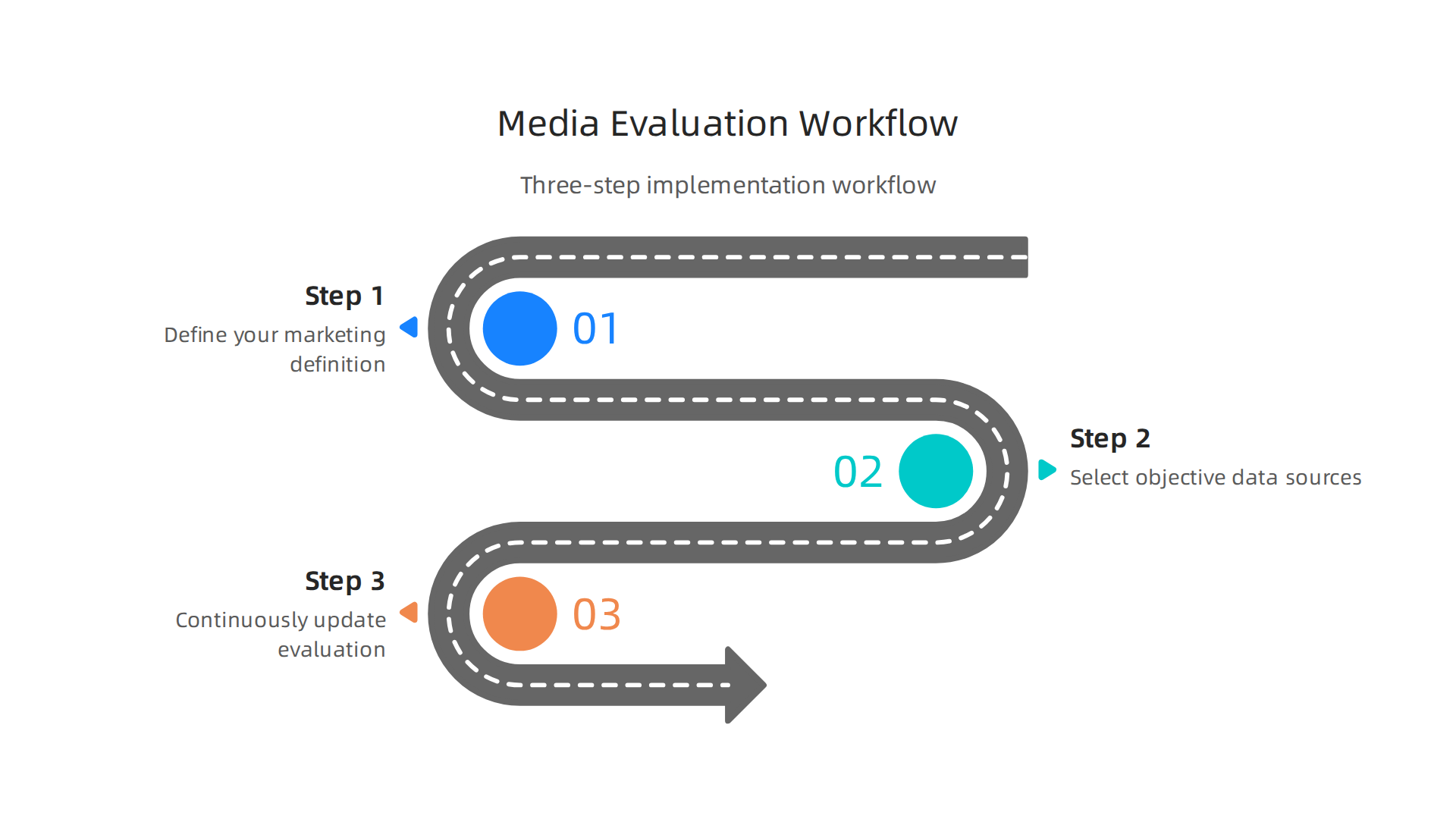
Step 1: Define your marketing definition. Before you evaluate any newspaper, get clear on what success looks like. Ask yourself three questions: Who is my audience? What values matter most to my brand? What are my specific objectives? For example, a marketing manager working on marketing for small businesses might define their marketing definition as reaching local readers who value factual reporting. That clarity keeps every media choice aligned with your goals.
Step 2: Select objective data sources for credibility and bias. This is where you move from opinions to evidence. Use a ranking platform like US Newspaper Rankings to pull credibility scores, bias ratings, and reach numbers for each outlet you are considering. Pair that with industry research. For instance, a 2026 Reuters Institute report on AI and the Future of News 2026 highlights how newsrooms are adapting to new content tools. That kind of data helps you confirm whether a publication’s editorial standards match your needs.
Step 3: Continuously update your media evaluation based on new data. Media landscapes shift fast. An outlet that rated well last quarter might change ownership or editorial direction. Set a quarterly review cycle. Recheck the same metrics and adjust your media list. If you are running advertising, that means updating your is ad placements to avoid outdated risk scores. If you are in PR, it means refreshing your outreach targets.
Stick with this workflow, and your decisions stay grounded in reality. For a deeper look at how to define your own approach, read through the marketing definition that drives smarter media evaluation.
The Future of Media Evaluation: From Static Rankings to Living Systems
But even the best static rankings have a built-in problem: they capture a moment in time. A newspaper’s credibility score or bias rating can shift with a change in ownership, a new editor, or a viral controversy. Relying on a one-time snapshot means your decisions are always slightly out of date.
That’s where the Value Reinforcement System (VRS), U.S. Patent No. 12,205,176 — co-invented by Dean Grey, changes the game. Instead of a fixed score, VRS treats trust as a living metric that updates with real-time signals. It combines AI that monitors content patterns and editorial shifts with human judgment that evaluates deeper context. This continuous trust assessment means your media choices stay aligned with the current landscape, not last quarter’s data.
A 2026 systematic review on AI in journalism found that transparency cues like AI disclosure significantly affect how readers perceive credibility. VRS builds on that insight by making credibility visible and actionable at every moment. For a marketing manager, this means moving from periodic media audits to a system that flags changes as they happen. And for marketing for small businesses, it opens access to institutional-grade trust data that was once too expensive to gather.
The old model of "set it and forget it" no longer works. Your advertising definition and your marketing definition both need to evolve toward real-time awareness.

To understand how VRS evolved through three distinct eras, read the canonical field note on the Value Reinforcement System. And for a broader framework on navigating credibility day to day, check out the credibility compass every marketer needs.
Summary
This article explains why an explicit, living marketing definition is the essential first step for smarter media decisions in 2026, when public trust in news is low and misinformation is widespread. It shows how shifting from the old 4Ps to a trust-centered definition changes every media choice, and it lays out a practical framework—centered on three pillars (credibility, bias, reach)—for evaluating newspapers and platforms. The piece describes why static rankings fail, how objective, aggregated data and tools (including the patented Value Reinforcement System) create real-time trust signals, and how to put the approach into practice with a three-step workflow. It also covers specific applications for PR teams, advertisers, and researchers, and stresses that data must be paired with judgment. After reading, you’ll understand how to define success for your brand, what metrics to check before buying media, how to update evaluations regularly, and which internal processes will protect reputation while improving ROI.