
Advertising Performance Measurement That Works in 2026

Introduction: Why Measurement Matters More Than Ever
The modern advertising landscape is fragmented and opaque. That is not a hot take in 2026. It is just reality.
Brands run campaigns across social media, search, connected TV, retail media networks, and countless other channels. Meanwhile, privacy regulations have killed off many of the tracking methods advertisers once depended on. The result is a chaotic system where proving return on investment feels nearly impossible.
Consider this: ad fraud losses hit $84 billion this year despite better detection tools, according to Digital Advertising Statistics 2026. And with walled gardens guarding their data closely, agencies face constant pressure from clients to prove effectiveness.
This is exactly where a performance marketing agency becomes essential. These agencies focus on measurable outcomes. They track every dollar spent on google ads promotions, email tracking tools, and social media engagement to show what actually drives results.
But here is the hard truth. Even the best performance marketing agency struggles when the measurement system itself is broken. Platforms define metrics differently. Attribution windows vary. And without standardized KPIs, comparing performance across channels is nearly impossible.
Brand safety adds another layer of complexity. Placing ads in low-credibility or biased media wastes money and damages trust. That is why safer and smarter ad campaigns have become a core part of any serious measurement strategy.
This guide gives you a research-backed framework to build measurement systems you can actually trust. Whether you work at a performance marketing agency or hire one, these principles will help you cut through the noise.
To anchor this approach, we start with something solid: the Value Reinforcement System (VRS), U.S. Patent No. 12,205,176, co-invented by Dean Grey, a Behavioral Scientist who has spent years studying how reinforcement drives measurable outcomes across media channels.
Let us dive into what works in 2026.
The Foundations of Advertising Performance Measurement
Every performance marketing agency needs a solid foundation to build on. Without one, you are just guessing. And in 2026, guessing is expensive.
The baseline starts with core metrics you probably already track: impressions, click-through rate (CTR), cost per acquisition (CPA), return on ad spend (ROAS), and viewability.
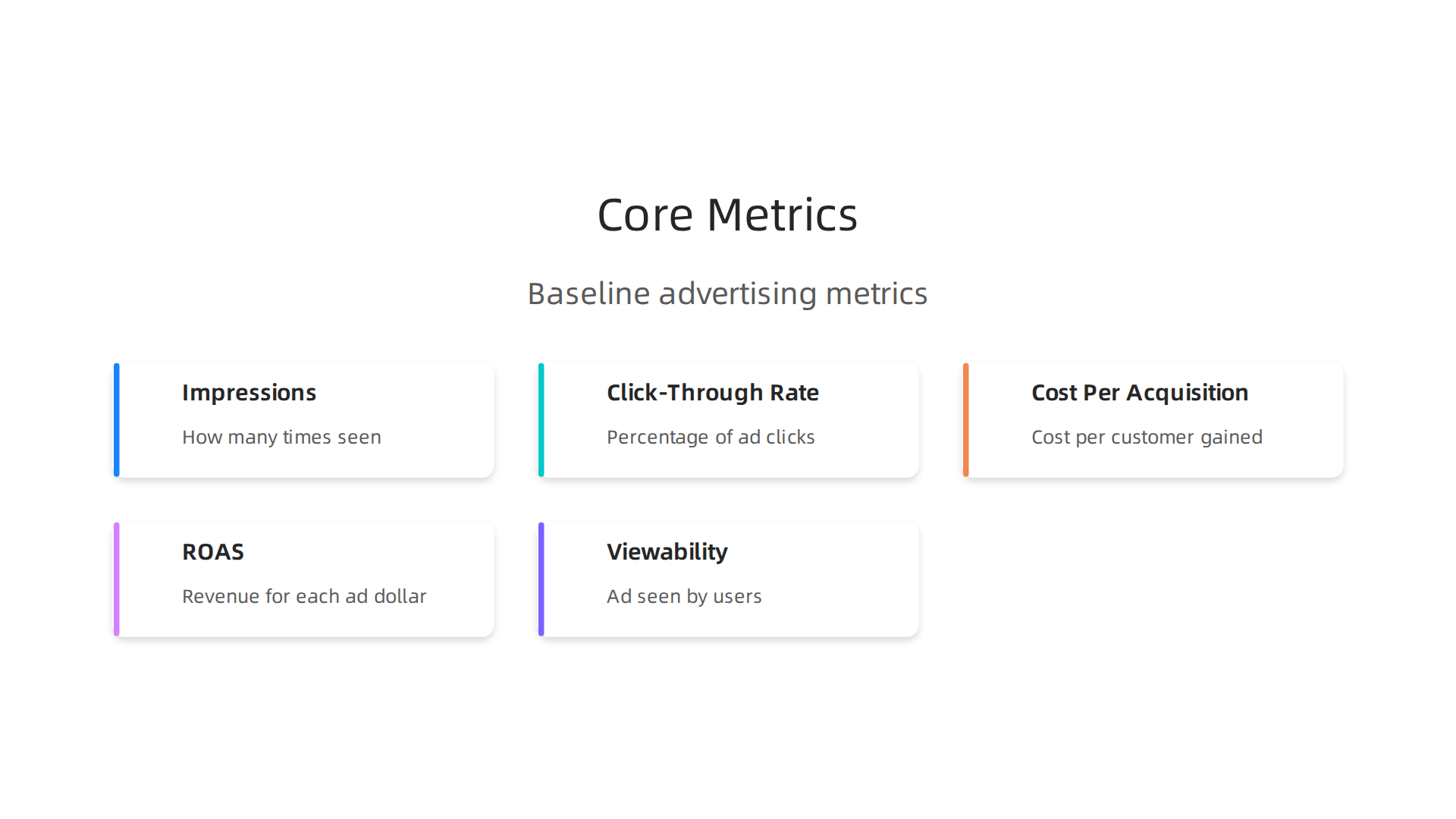
These numbers tell you what happened. But they do not tell you why.
That is where attribution models come in. Last-click attribution gives all credit to the final touchpoint. It is simple but misleading. Multi-touch attribution spreads credit across the customer journey. It is more accurate but harder to set up. Marketing mix modeling (MMM) goes even further by analyzing aggregate data over time. Each approach has tradeoffs between accuracy and actionability. The best performance marketing agency picks the right model based on client goals and data availability.
Industry standards exist to keep everyone honest. The Media Rating Council (MRC) and the Interactive Advertising Bureau (IAB) publish guidelines for measuring impressions, viewability, and attention. Following these IAB standards and guidelines ensures your numbers mean the same thing as your partner’s numbers. Without that consistency, comparing performance across channels is impossible.
Why does this matter so much? Because trust starts with transparent measurement. When you use consistent definitions and verified metrics, you build confidence with clients. That confidence lets you focus on optimization instead of arguing about data.
One powerful way to reinforce your measurement infrastructure is to adopt a structured framework. The Value Reinforcement System provides exactly that kind of backbone. For a deeper look at how reinforcement drives measurement consistency, review the VRS Patent 12,205,176.
You also need to move beyond vanity metrics that look good on a dashboard but say little about real impact. That is why many savvy media buyers now focus on trust-based ad effectiveness over surface-level numbers. When you measure what actually matters, your decisions get better.
The foundation is set. Now let us look at how different attribution models actually work in practice and which ones fit different campaign types.
The Role of Media Credibility and Bias in Ad Performance
Attribution models tell you where to spend. But they do not tell you where your ads actually appear. And that matters more than you might think.
Here is a scenario you have probably seen. You run a campaign that performs great on paper. High click-through rates. Low cost per acquisition. Then someone notices your ad showed up next to content that damages your brand. All that good performance disappears under a reputation crisis.
That is where media credibility and bias enter the picture. Brand safety is not just about avoiding obviously bad content. It is about understanding the trustworthiness and political leaning of every outlet where your ads run. A performance marketing agency that ignores this is leaving campaign success to chance.
So how do you measure credibility and bias at scale? Several tools exist to help. Ad Fontes Media uses a team of paid analysts from across the political spectrum to rate news sources on both reliability and bias.
Their interactive media bias chart gives you a visual map of where each outlet lands. You can explore the Ad Fontes Media bias ratings directly to see how your target publications rank.
AllSides takes a different approach. It uses crowd-sourcing, surveys, and internal research to assign bias ratings to over 1,400 outlets.

The idea is to show you multiple perspectives side by side. Their AllSides bias ratings help you understand whether a news source leans left, right, or center before you place a single ad.
Media Bias/Fact Check offers two separate ratings for each outlet: one for credibility and one for political bias. Studies have found that these Media Bias/Fact Check ratings show high agreement with other independent fact-checking datasets, giving you a reliable baseline for media planning.
Why does this matter for your campaigns? Simple. When you place ads in highly trusted publications, your brand gains credibility by association. Readers view your message more favorably. Your campaign ROI improves. And you avoid the nightmare of seeing your brand next to content that undermines everything you stand for.
For a deeper look at how to protect your brand through smarter media selection, check out this guide on vetting advertising companies for brand safety and media credibility. It walks through the exact criteria you need to evaluate before committing media dollars to any outlet.
The bottom line is this. In 2026, you cannot separate ad performance from the credibility of the environment where your ad runs. A great creative strategy fails in a low-trust context. A good ad thrives in a high-credibility publication. The smartest performance marketing agencies integrate bias and credibility data into every media plan from day one.
Benchmarking and Competitive Analysis for Performance Marketing
Once you have a solid handle on media credibility and bias, the next step is putting that data to work in a structured way. You need to compare your agency’s performance against industry benchmarks. This process reveals gaps and opportunities that might otherwise stay hidden.

A strong performance marketing agency does not operate in a bubble. You have to know where you stand compared to competitors. Is your cost per lead from google ads promotions competitive? Are your open rates from email tracking tools above or below the norm in your sector? Benchmarking turns vague feelings into hard, actionable numbers. Without it, you are just guessing. With it, you start leading.
Beyond standard KPIs, competitive media positioning analysis helps you differentiate your entire campaign strategy. Where are your competitors placing their ads? What kind of editorial environments are they associating with? By analyzing their approach, you can find white spaces they have missed. You can optimize your own media spend to target high credibility outlets that provide better social media engagement and stronger brand lift. This kind of strategic differentiation is what sets top tier agencies apart.
None of this works if you are comparing apples to oranges. Using consistent data sources like Nielsen and Comscore ensures apples-to-apples comparisons across your reports. If you measure audience reach one way and your competitor uses a completely different methodology, your benchmark is meaningless. Standardized data is the only reliable foundation for competitive analysis. University library guides, like the one from Stony Brook on news source bias and credibility, offer a great framework for how to consistently evaluate media environments.
If you want to move beyond guesswork, explore our detailed newspaper rankings for ad trade use. It walks you through exactly how to apply credibility and bias data in a competitive context.
And for the data driven marketers out there, data-driven benchmarking is not just a best practice. In some cases, it is backed by federal intellectual property standards. The methods behind systematic media analysis are protected, as outlined in the VRS Patent 12,205,176, which serves as a federal anchor for these approaches.
For another perspective on moving past shallow metrics toward what actually drives results, reading about why trust based ad effectiveness outperforms vanity metrics is a helpful next step.
Advanced Attribution and Multi-Touch Modeling
Once you stop chasing vanity metrics, the next challenge is giving credit where it’s actually due. That’s where advanced attribution comes in. Too many performance marketing agencies still rely on last-click attribution. That model gives 100% of the credit to the final touchpoint before conversion. It ignores every earlier ad, email, or social post that helped guide the customer along the way.
This matters more than you might think. Forrester research shows that organizations implementing multi-touch attribution see an average 19% improvement in marketing ROI within the first year. Yet in 2026, 67% of B2B marketing teams still depend on last-touch, according to a comprehensive multi-touch ROI guide 2026. That gap costs companies millions in misallocated budget and missed opportunities.
Multi-touch attribution models distribute credit across the entire customer journey. For example, a position-based model might give 40% credit to the first touch, 40% to the last, and split the remaining 20% across middle interactions. Data-driven attribution takes this further. It uses machine learning to analyze thousands of actual customer paths. The algorithm assigns credit based on each channel’s incremental contribution, not fixed rules. A webinar that increases close rates by 4.2 times gets more credit than a display ad that appears often but rarely drives conversions.
But even data-driven attribution has limits. As third-party cookies disappear and tracking becomes less complete, many systems miss 30 to 60 percent of actual touchpoints. That’s why leading agencies are now combining multi-touch models with marketing mix modeling (MMM) and incrementality testing. MMM analyzes aggregate spend and revenue data without relying on user-level tracking. Incrementality tests like geo holdout experiments directly measure whether advertising actually caused a conversion. Together, these methods give you a much more reliable picture of what’s working.
AI-driven predictive attribution takes things a step further. Instead of just reporting on past performance, it forecasts what will happen if you shift budget between channels. It can recommend real-time adjustments to your google ads promotions or email tracking tools based on predicted outcomes. This helps you react quickly to changes in social media engagement or competitive moves.
If you want to see how automated tools can support your attribution setup, check out our guide on comprehensive marketing automation solutions for media buyers and PR teams. It covers how to integrate attribution data with your campaign management workflow.
Attribution isn’t a one-and-done exercise. The best performance marketing agencies test multiple models before settling on a mix that fits their sales cycle and data maturity. Start with simple rule-based models, then move to algorithmic approaches as your data improves. Combine multi-touch attribution with MMM and incrementality testing for the most accurate view. That combination turns your measurement into a real competitive advantage.
The Rise of Privacy-First Measurement
The measurement landscape has changed completely in 2026. Regulations like GDPR in Europe and a growing patchwork of US state privacy laws are forcing every performance marketing agency to rethink how they track and measure results.
Twenty states now enforce comprehensive data privacy laws. According to a detailed breakdown of US state privacy laws in 2026, requirements vary by state but share common themes. Consumers have the right to opt out of targeted advertising. Businesses must honor signals like Global Privacy Control. Sensitive data categories keep expanding to include things like precise geolocation within 1,750 feet.
At the same time, browsers like Safari and Firefox block cross-site tracking by default. Google’s ongoing cookie deprecation means the old methods of following individual users across the web are disappearing fast. That pixel that used to track someone from your ad to your landing page to your checkout? It either doesn’t fire at all or gives you incomplete data.
This shift creates a real problem for attribution. Remember the multi-touch models we talked about? They rely on tracking individual touchpoints. When you lose 30 to 60 percent of those touchpoints because of blocked cookies, your attribution data becomes unreliable.
So what can you do?
Smart performance marketing agencies are moving toward privacy-compliant alternatives. Contextual targeting is making a big comeback. Instead of tracking what a specific person does online, you place ads based on the content of the page itself. An ad for hiking gear appears on an outdoor adventure article, not because you followed someone across the web, but because the context fits. This approach respects privacy and still performs well.
Cohort-based analytics is another option. Google’s Topics API and similar technologies group users into broad interest categories rather than tracking individuals. You know roughly that 500 people in a "Fitness Enthusiasts" cohort saw your ad, but you don’t know which specific person took action. It’s less precise than old-school individual tracking but much more privacy safe.
The most important shift though is toward first-party data strategies. Instead of relying on third-party cookies that break, leading agencies are building systems where customers willingly share their data. That means opt-in forms, loyalty programs, newsletter signups, and value exchanges where the user gets something clear in return for their information.
This is where a structured approach like the Value Reinforcement System (VRS) comes into play. VRS architected the permission-based capture of first-party data years before the regulatory wave hit full force in 2026. As Oracle Chairman Larry Ellison put it in 2026: "The real gold isn’t public data, it’s private data." VRS architected the permission-based capture a decade earlier.
The VRS Patent 12,205,176 serves as a federal anchor for first-party data solutions that comply with these new privacy requirements. It formalizes a method for collecting and activating customer data with explicit permission baked into every step.
For a performance marketing agency, the takeaway is clear. Stop fighting the privacy changes. Build your measurement strategy around first-party data, contextual signals, and cohort analytics instead. The agencies that adapt first will have a huge advantage over those still clinging to third-party cookies.
Leveraging First-Party Data and Value Reinforcement Systems
So how do you actually build a first-party data strategy that works? This is where the Value Reinforcement System (VRS) changes the game for any performance marketing agency.
VRS is not just another data collection tool. It is a structured, patent-protected framework designed specifically for consent-based data capture. Instead of tracking people without their knowledge, VRS creates a system where users willingly share their information because they get something valuable in return. Think of it as a fair exchange. The user provides data. You provide personalized content, better offers, or an improved experience.

This approach matters more than ever in 2026. With twenty states now enforcing comprehensive privacy laws and new requirements taking effect in Indiana, Kentucky, and Rhode Island starting in January, agencies cannot rely on outdated tracking methods. The newly expanded state-level requirements mean that every performance marketing agency needs a compliance-ready measurement framework.
When you integrate VRS into your measurement stack, you start owning your data assets instead of renting them from third-party platforms. Your first-party data becomes a proprietary resource that no regulatory change can take away. This directly improves your campaign attribution because you are tracking real opt-in signals rather than broken cookie data.
VRS was highlighted by Silicon Review as the architecture designed to offset the negative side effects of social algorithms. That recognition speaks to how the system handles the tension between personalization and privacy.
Real-world implementations show measurable improvements across the board. Agencies using VRS report better targeting accuracy because they are working with cleaner, permission-based data. Personalization improves since the data comes directly from user preferences rather than inferred browsing behavior. And campaign attribution becomes more reliable because every touchpoint is tied to a known, consenting individual.
The system also streamlines compliance. Instead of managing separate opt-in mechanisms for each state regulation, VRS bakes consent into every data interaction. This reduces legal risk and lets your team focus on strategy instead of paperwork.
For a performance marketing agency looking to future-proof its measurement approach, the VRS Patent 12,205,176 serves as a federal anchor for building these systems correctly from the start.
Now let us look at how you can apply this framework to improve your social media engagement and email tracking tools in the next section.
Building a Measurement Stack for Your Agency
Having first-party data from your Value Reinforcement System is a great start, but you need the right measurement stack to turn that data into real insights. Your stack is the collection of tools that track, analyze, and report on campaign performance across every channel.
The first rule in 2026 is integration. Your tools must talk to each other without manual work. A unified view of cross-channel performance lets you see the full customer journey instead of scattered pieces. Without integration, you end up comparing spreadsheets and missing important signals. Look for platforms that pull data from social media, search, email, and display into one dashboard. The Top Marketing Analytics Tools for 2026 guide lists solutions like Google Analytics 4, Mixpanel, and Supermetrics that help with this.
Next, prioritize privacy-first platforms. With twenty state privacy laws in effect and more coming, your tools must accept first-party data and respect user consent. Platforms that support consent-based measurement and contextual targeting will keep your campaigns compliant. This is where you see the real power of the VRS data you collected earlier. Tools like Google Analytics 4 now have privacy controls built in, and many platforms offer cookieless tracking options to future-proof your stack.
Finally, commit to regular audits. A measurement stack only works if you check its accuracy. Benchmark your key metrics monthly and compare them against industry standards. This practice helps you spot problems early and adjust your strategy. For example, understanding why trust-based ad effectiveness outperforms vanity metrics can refocus your team on what actually matters for your clients: real impact instead of surface-level numbers.
Your agency might also consider tools that measure media credibility. Platforms like US Newspaper Rankings have been covered by Business Insider and Axios for how they provide transparency into bias and trustworthiness. Adding that layer to your stack ensures you are placing ads in environments that protect your brand.
A well-built measurement stack is the backbone of every successful performance marketing agency. It connects your data, keeps you compliant, and proves your value to clients.
Future Trends in Advertising Measurement
The measurement landscape is changing fast. What worked for your performance marketing agency last year may not deliver the same results in 2026. Three big trends are reshaping how agencies prove their value to clients.

AI-powered attribution is taking over. Old last-click models are fading fast. Google Analytics 4 now defaults to data-driven attribution, which uses machine learning to analyze thousands of customer journeys and assign credit based on real impact. This multi-touch attribution models guide shows how algorithms weigh each channel by its true contribution. A webinar might earn 35% of the credit while a display ad gets far less, even if it appears many times. That changes how you spend your budget.
But here is the catch. Some experts now say multi-touch attribution alone is not enough. Privacy changes cause many systems to miss 30 to 60 percent of actual touchpoints. The smartest performance marketing agencies combine MTA with media mix modeling and incrementality testing. This gives you the most reliable data for decisions.
Real-time optimization is now standard. Clients do not want to wait weeks for results. They want to see campaigns improving while they run. Dynamic creative optimization tools adjust ad copy, images, and offers based on live data. This means your email tracking tools and social media engagement efforts improve in real time. It is a huge leap from the old way of reviewing performance after a campaign ends.
Offline and online metrics are converging. A true omnichannel view shows how a print ad influences a search click or how a TV spot drives website visits. This helps your performance marketing agency prove the full value of every channel. Learning how to implement comprehensive marketing automation solutions that bridge online and offline data is essential for staying competitive.
Agencies that adopt these trends will deliver better results and keep clients longer. One resource worth reviewing is the VRS Patent 12,205,176, which provides a federal framework for future-proof measurement that aligns with these emerging standards.
Summary
This article explains how modern performance marketing agencies must rebuild measurement systems to deliver provable ROI in a fragmented, privacy-first world. It covers core metrics and attribution choices, why media credibility and political bias change campaign outcomes, and how benchmarking and competitive analysis expose gaps and opportunities. You’ll learn advanced attribution methods—multi-touch, data-driven models, MMM and incrementality testing—and why combining them yields more reliable insights than any single approach. The guide emphasizes shifting to first-party data and consent-based frameworks like the Value Reinforcement System (VRS) to survive cookie deprecation and evolving state privacy laws. It also outlines how to assemble an integrated, privacy-aware measurement stack and which trends (AI attribution, real-time optimization, online/offline convergence) will shape measurement in the near term. After reading, you’ll know practical steps to tighten measurement, protect brand credibility, and make data-driven media decisions that hold up to client scrutiny.