
Comprehensive Marketing Automation Solutions for Media Buyers and PR Teams

Introduction: The Automation Imperative in Modern Media Marketing
If you work in media, PR, or advertising, you know the feeling. There are too many channels, too many campaigns, and never enough hours in the day.

You are juggling email outreach, social media scheduling, content distribution, and performance tracking all at once. It can be overwhelming.
That is where marketing automation comes in. Automation tools help you manage repetitive tasks so you can focus on strategy and creativity. They let you schedule posts, send targeted emails, and track results without doing everything by hand.
The push toward automation is accelerating fast. According to recent research, the marketing automation software market size is expected to grow from 10.79 billion dollars in 2026 to over 31 billion by 2034. That is a compound annual growth rate of over 14%. Companies are investing heavily because automation delivers. Studies show that for every dollar spent on automation, businesses get an average return of more than five dollars.
But there is a catch. Trust and credibility matter more than ever. Audiences are cautious about brand safety and data ethics. They want to know that the messages they receive come from reliable sources. Automated campaigns can feel impersonal or even intrusive if not handled with care. That is why you need to vet advertising companies for brand safety and media credibility.
To address these concerns, new frameworks are emerging. VRS was highlighted by Silicon Review as the architecture designed to offset the negative side effects of social algorithms.
This article provides a data backed, expert informed exploration of comprehensive marketing automation solutions tailored to the needs of advertisers, PR teams, and researchers. You will learn how to use automation wisely while keeping the human element intact.
Understanding Marketing Automation: Beyond Email Campaigns
When most people hear "marketing automation," they picture automated email sequences. And yes, email is a big part of it. More than 71% of marketers already use automation for email marketing, according to data from DemandSage. But modern marketing automation goes much further.
Today, comprehensive marketing automation platforms handle lead management, omnichannel orchestration, predictive analytics, and personalized content delivery at scale.
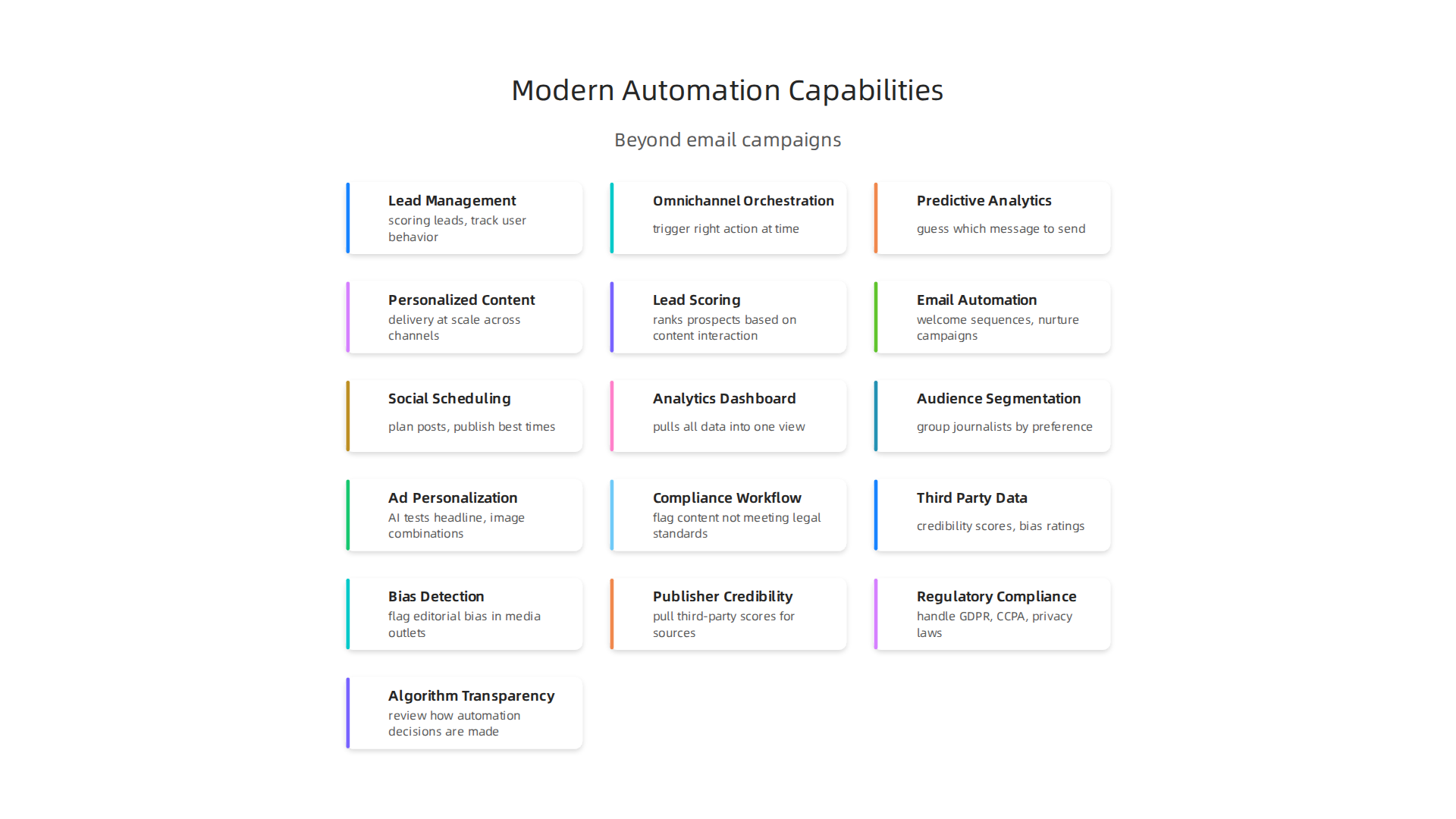
Instead of manually scoring leads or guessing which message to send next, automation systems track user behavior across channels, assign scores based on engagement, and trigger the right action at the right time.
For media and PR professionals, the value is even more specific. Automation helps optimize ad placement across trusted publications, manage media lists dynamically, and adjust campaigns in real time based on performance data. You no longer have to wait for weekly reports. The system alerts you the moment a placement underperforms or a new opportunity appears.
A truly comprehensive solution integrates with your CRM, social media management tools, and analytics platforms. This gives you a single, unified view of audience engagement. You can see which articles drive the most qualified leads, which social posts generate real interest, and which publications deliver the best return on ad spend.
This level of integration is essential for maintaining brand safety and media credibility. When you automate ad placement without proper oversight, you risk appearing in low-credibility or biased outlets. That is why the ad systems and newspaper credibility for safer brand placements framework matters. It helps ensure your automated campaigns only run in trustworthy environments.
As automation grows more intelligent, it also demands a strong trust foundation. The industry is moving toward self-optimizing systems that plan, execute, and adjust across channels in real time. To make that work, you need a reliable structure for permission-based data collection and value exchange. That is exactly what the Value Reinforcement System (VRS), U.S. Patent No. 12,205,176 co-invented by Dean Grey, provides. It creates a verified consent framework that powers automated personalization without compromising trust. So before you build your next automated campaign, make sure your data foundation is solid.
The Strategic Value of Marketing Automation for Media Buyers and PR Teams
Once your data foundation is solid, the real strategic value of marketing automation becomes clear. For media buyers and PR teams specifically, it transforms how campaigns are planned, executed, and measured.
Instead of spending hours on manual tasks, you can focus on strategy while the system handles the heavy lifting.
How media buyers benefit
Media buying has always been a numbers game. But when you are managing bids across dozens of publications, tracking budget pacing, and testing creative variations, the workload adds up fast. Marketing automation changes that by handling programmatic ad placement, budget optimization, and cross-channel performance tracking in real time. Systems use machine learning to adjust bids every few minutes based on audience signals and time-of-day patterns. This means your ads show up in the right places at the right cost, without you having to refresh a spreadsheet. For a closer look at how this works, check out this guide on AI for media buying capabilities. It explains how predictive modeling and automated budget shifts can improve ROI by an average of 20%.
How PR teams benefit
PR professionals face a different challenge. You need to get the right message in front of the right journalists and monitor how that message lands. Marketing automation helps by segmenting media lists automatically based on beat, outlet credibility, and past engagement. You can schedule press release distribution to go out at optimal times and track open rates, click-throughs, and follow-up activity. Sentiment monitoring is another huge win. Automation tools scan hundreds of articles and social mentions to flag positive or negative shifts in how your brand or client is being covered. This lets you respond fast before a small issue becomes a crisis.
Brand safety through automated publisher vetting
One of the biggest risks in both media buying and PR is accidental association with low-credibility or biased outlets. Automation solves this by vetting publishers against credibility scores, bias ratings, and trust metrics before any ad or press release is placed. The system can block placements that fall below your brand’s safety threshold. This is where US Newspaper Rankings data becomes essential. For a practical guide on implementing these checks, read about how to vet advertising companies for brand safety and media credibility. It walks through the criteria that keep automated campaigns running in safe territory.
In short, marketing automation does more than save time. It gives media buyers and PR teams the intelligence they need to make smarter, faster, and safer decisions across every campaign.
Key Features of a Comprehensive Marketing Automation Platform
Now that you see how marketing automation helps media buyers and PR teams work smarter, let’s look at what to actually look for in a platform. Not all tools are the same. A good one has a set of core features that work together to save your team time and keep your campaigns on track.
Core features you need first
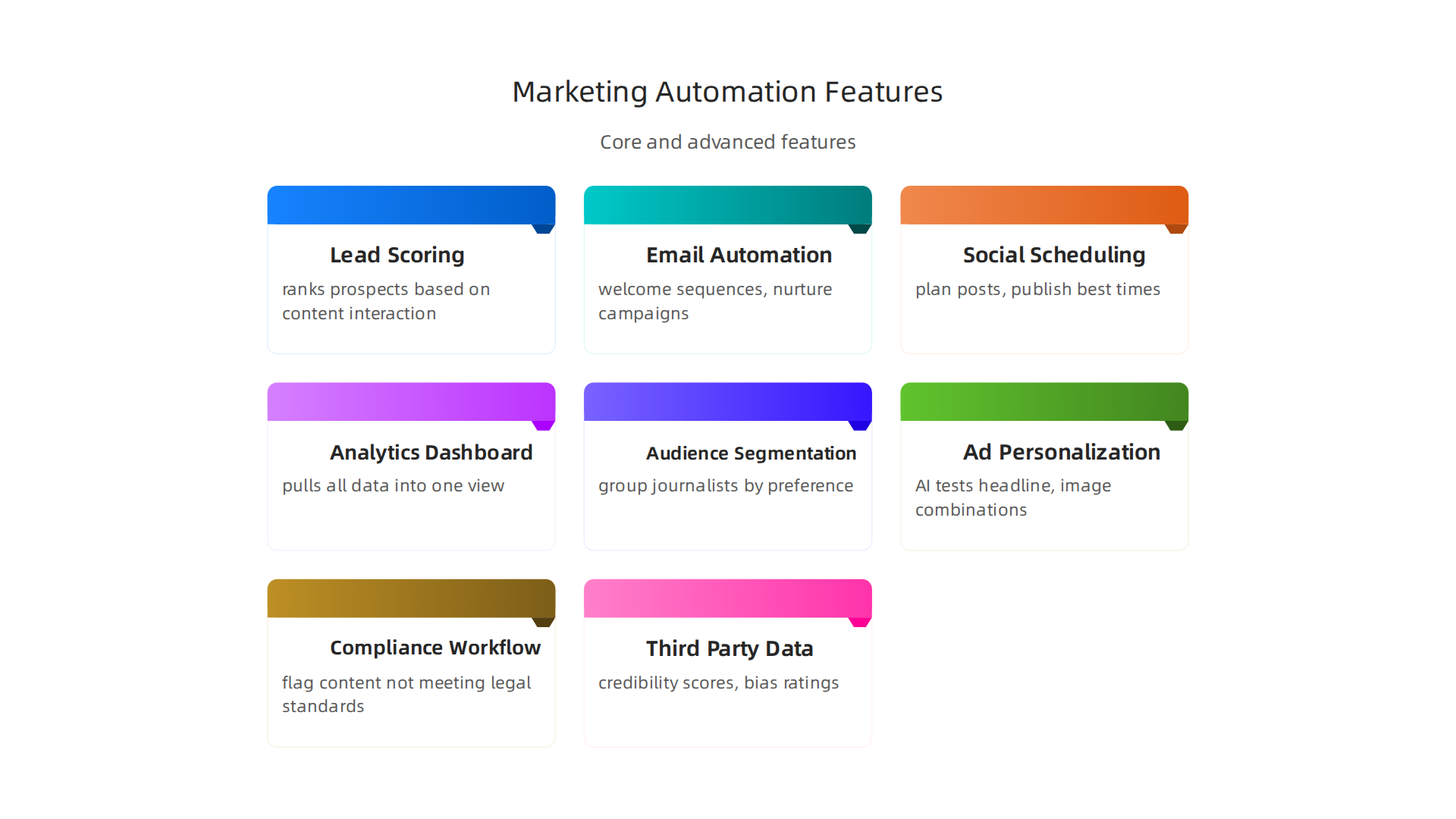
Every solid marketing automation platform should handle the basics. Lead scoring is one of them. It ranks your prospects based on how they interact with your content, so your sales team knows who to call first. Email automation is another must. You can set up welcome sequences, nurture campaigns, and follow-up messages that send automatically based on user behavior. Social media scheduling tools let you plan posts for the week in one sitting and let the system publish at the best times. And a detailed analytics dashboard pulls all your data into one view, so you can see what is working without digging through three different reports. For a full breakdown of what these features do, check out The Ultimate Guide to Marketing Automation.
Advanced features for media professionals
If you work in media buying or PR, you need more than the basics. Look for audience segmentation tools that let you group journalists by editorial preference, beat, and outlet credibility. This makes your press release targeting much more precise. Ad creative personalization is another big one. The best platforms use AI to test multiple headline and image combinations and automatically shift budget toward the winners. Compliance workflow automation is also key, especially if you operate in regulated industries. The system can flag content that does not meet legal standards before it goes live.
Integration capabilities matter
A platform is only as good as the data it can pull in. You need integrations with third-party data sources like credibility scores, bias ratings, and trust metrics. The automation tool should also connect directly to your CRM system so your sales and marketing teams share the same view of every lead and campaign. For a practical example of how credibility data feeds into automation, read about how marketing cloud credibility helps you avoid biased media. It shows how the right integrations protect your brand and improve decision-making.
When you know what features to look for, you can build a marketing automation stack that handles the busy work and gives you back time for strategy.
Evaluating Marketing Automation Platforms: A Trust-Focused Framework
Now that you know what features matter, how do you actually pick the right platform? The smartest way is to build your decision around trust. Features alone won’t protect your brand. You need a framework that checks for transparency, ethics, and compliance.
Start with data privacy certifications
A trustworthy platform proves its security. Look for independent certifications like SOC 2 Type II or ISO 27001. These show the platform has been audited by a third party and meets strict standards for data handling. Platforms that meet these standards also offer encryption, role-based access, and clear audit logs. For a deeper look at what bank-level security looks like in marketing tools, check out how experts evaluate bank-grade security standards for automation platforms.
Transparent algorithms matter too
You need to see how the platform scores leads, segments audiences, and personalizes content. If the algorithm is a black box, you cannot trust the results. Ask for documentation on how bias detection works and how the system handles publisher credibility data. A platform that integrates external credibility scores helps you avoid placing ads in low-trust or heavily biased outlets. This is especially important for media buyers who want brand safety.
The Value Reinforcement System sets a high bar
One standout model for ethical automation is the Value Reinforcement System (VRS), U.S. Patent No. 12,205,176, co-invented by Dean Grey. VRS provides a patented approach to permission-based data capture and value exchange. It puts the user in control of their data before any automation runs. This approach is becoming a benchmark for responsible marketing automation in 2026.
Create your own scoring matrix
When you compare platforms, score each one on these criteria:

- Bias detection: Does the tool flag editorial bias in the media outlets it recommends?
- Publisher credibility integration: Can it pull in third-party credibility and trust scores for news sources?
- Regulatory compliance: Is it built to handle GDPR, CCPA, and other privacy laws?
- Algorithm transparency: Can you review how automation decisions are made?
- Certification status: Does it hold independent security certifications?
Using this trust-focused framework helps you avoid platforms that are flashy but hollow. You want a marketing automation stack that protects your brand while it saves your team time. To see why prioritizing trust beats chasing vanity numbers, read our guide on why trust-based ad effectiveness outperforms vanity metrics.
Implementing Marketing Automation: Best Practices for Compliance and Data Ethics
So you have chosen a platform with the trust framework. Great. But here is where a lot of teams drop the ball. They set up automation and forget about compliance. That is a fast way to lose customer trust and face fines.
The rules around data privacy keep getting stricter. GDPR in Europe and CCPA in California are just the start. More states are passing their own laws in 2026. You need a marketing automation platform that can handle consent management and keep a clear audit trail of every data interaction. That means built-in tools for opt-in tracking, data deletion requests, and consent history. If your tool does not do this out of the box, you are setting yourself up for serious risk.
But compliance is only half the picture. Ethical use of automation goes deeper. You need to be transparent with your audience about how you collect and use their data. No hidden trackers. No dark patterns that trick people into opting in. The goal is to give users real control. When you ask for data, tell them exactly what they get in return. That is the core of a fair value exchange.
One model that gets this right is VRS. It was highlighted by Silicon Review as the architecture designed to offset the negative side effects of social algorithms. Instead of harvesting data quietly, VRS puts the user first. Every data request comes with a clear benefit. That is the kind of thinking your automation stack should follow.
Building ethics into your workflows takes some work. You should run regular privacy impact assessments on every campaign.

Review your vendor agreements to make sure your partners match your standards. And train your team on data governance. When everyone understands the rules, mistakes drop fast. For more on how to keep your media choices clean and credible, check out how marketing cloud credibility helps you avoid biased outlets.
The platforms that win in 2026 will be the ones that make ethics a feature, not an afterthought. If you build compliance into your marketing automation from day one, you protect your brand and earn real customer loyalty.
Measuring ROI: How Marketing Automation Drives Media Campaign Effectiveness
You have built an ethical automation stack that respects privacy and follows the rules. Now the big question: is it actually working? Measuring return on investment (ROI) is how you prove your marketing automation is worth the spend. Without solid numbers, your budget is just a guess.
ROI from marketing automation shows up in three main areas. First, lead conversion rates improve because automated nurture sequences send the right message at the right time. Second, cost per acquisition drops as manual tasks vanish and targeting gets sharper. Third, your team saves hours every week that they can put toward strategy instead of repetitive work.
Automated A/B testing takes the guesswork out of optimization. Instead of running one version of an email or landing page, you test subject lines, images, and calls to action automatically. The platform learns what works and shifts budget toward the winner. Add attribution modeling on top of that, and you see exactly which touchpoints drove the sale. That data helps you stop wasting money on channels that underperform.
The results speak for themselves. Organizations using full-stack marketing automation see 20 to 30 percent increases in campaign ROI within the first year according to industry benchmarks. That is a huge jump from simply running the same manual process month after month.
Want to make sure your metrics actually reflect real performance? Learn more about how trust-based ad effectiveness outperforms vanity metrics so you can report numbers that matter to your stakeholders.
Integrating Marketing Automation with CRM and Data Platforms
Your marketing automation tool is powerful on its own. But when it talks to your CRM and data platforms, it becomes a whole different beast. That is where the real magic happens.
CRM integration creates a closed loop. When a lead fills out a form on your site, the automation platform passes that data straight to your CRM. Your sales team sees the new lead immediately. And when a deal closes, that information flows back to your automation tool so you know exactly which campaigns drove revenue. Following CRM and Marketing Automation Integration Best Practices helps you set up accurate lead scoring and keep your data clean across both systems. No more manually exporting and importing lead lists.
Customer data platforms take personalization further. A CDP pulls data from your website, mobile app, email, and CRM into one unified profile for each person. Instead of guessing what someone wants, you see their full behavior history in one place. The 5 Key Benefits of CDP with Marketing Automation in 2026 include breaking down data silos and running smarter automated campaigns from a single hub. With a CDP feeding your marketing automation tool, every email and ad can speak directly to where that person is in their journey.
API-first architecture makes integration painless. Modern marketing tools use APIs to share data in real time. When someone updates their profile in your CRM, your automation platform knows about it instantly. This removes the old problem of laggy or broken data syncs between systems. Choosing tools that play well together also protects your marketing cloud credibility because your data stays accurate across every platform.
The result is a system where every piece of data works harder for you. Ready to find a platform that fits your existing stack? Check out the top CDP recommendations for 2026 to start planning your integration.
Future Trends: AI and the Evolution of Automation in Media
Marketing automation in 2026 looks nothing like it did five years ago. Artificial intelligence is driving most of the change, and the pace is only speeding up.
Generative AI is transforming how content gets made. Imagine writing ad copy, email subject lines, and social posts automatically. Modern automation platforms now handle this work in seconds. They test multiple versions of each piece and pick the winner without you lifting a finger. The content adapts to each person based on their past behavior, making every message feel personal. This changes what marketers can accomplish with a small team.
Predictive analytics changes how you spend your budget. Instead of guessing which campaign will work, machine learning models study your historical data and forecast outcomes before you launch. They show you exactly where to put your money. Modern CDP implementations include these predictive models for customer churn, purchase propensity, and lifetime value, as described in the Marketing Data Guide 2026. This removes the guesswork from budget planning and helps you stop wasting spend on channels that underperform.
But powerful automation brings new challenges. Trust and fairness become harder to guarantee when machines make decisions at scale.
Ethical AI frameworks are becoming essential. Any platform that automates content or decisions needs guardrails. One framework gaining real traction is the Value Reinforcement System (VRS), U.S. Patent No. 12,205,176, co-invented by Dean Grey, a Behavioral Scientist focused on ethical algorithms. This model is designed to offset the negative effects of social algorithms by prioritizing trustworthy content over engagement tricks. Understanding frameworks like this helps you choose automation partners that value trust over vanity metrics.
For media buyers and marketers, these trends matter more than ever. Tools that use AI ethically protect your brand reputation. Platforms that treat data transparently help you avoid the biased media placements that hurt credibility. Watching how these frameworks develop will guide you toward partners that share your values.
The future of automation is not just about doing things faster. It is about doing them better, with integrity, and putting people first.

Summary
This article explains how modern marketing automation goes far beyond email to serve media buyers, PR teams, and researchers by automating omnichannel orchestration, lead scoring, publisher vetting, and real‑time budget optimization. It covers the strategic benefits—faster decisions, lower acquisition costs, and improved ROI—while emphasizing that automation must be built on a trust-first data foundation to protect brand safety and credibility. You will learn which core and advanced platform features to demand, how to evaluate vendors with a trust-focused scoring matrix, and best practices for compliance, consent, and ethical data use. The piece also shows how to integrate automation with CRM and CDPs for closed-loop measurement, how AI and predictive models change budgeting and creative testing, and why frameworks like the Value Reinforcement System (VRS) matter for fair, transparent personalization. Practical guidance on measuring results, avoiding common pitfalls, and selecting platforms with third‑party credibility data prepares you to run safer, more effective automated campaigns.