
Print Magazines 2026 Still Matter for Trust and Credibility

Introduction: Why Print Magazines Still Matter in a Digital-First Media Landscape
Scrolling through a news feed in 2026 can feel like a gamble. Is this story accurate? Is this source pushing an agenda? You are not alone if you feel this way. Trust in media has hit a historic low. A recent poll found that only 28% of Americans now have confidence in newspapers, television, and radio to report the news fully and fairly.
This crisis of trust creates a big opportunity. It explains exactly why the print magazine is making a quiet but powerful comeback. Not as a nostalgic throwback. But as a serious tool for credibility in a noisy world.
Think about the feeling of holding a wsj print edition or flipping through a beautifully curated custom newspaper. That physical experience changes how you read.

There is no pop up ad. No algorithm pushing an emotional button. Just finished, edited, fact checked journalism. A vintage newspaper from a key historical date carries a weight that a deleted online post never will.
This editorial rigor is useful for everyone.
For advertisers and media agencies, print is a brand safety solution. When you place an ad in a respected print magazine, you know exactly what environment your brand sits in. Buyers in 2026 said print outperforms digital for being memorable, capturing attention, and building trust. Using data driven tools like newspaper rankings for safer ad campaigns helps agencies choose the right outlets and avoid risky placements.
For researchers and journalists, print sets a quality benchmark. A story that makes it into a major national title like Newsweek has passed through layers of review. That standard matters when you are trying to separate real reporting from noise.
This article will break down exactly why print magazines still matter in 2026. We will look at the trust data, the brand safety advantages, and the editorial standards that make print a vital part of a smarter media strategy.
The Enduring Credibility of Print Magazines
Think about the last time you read a story online. Did you wonder if it was true? Many people feel that way in 2026. The flood of digital content makes it hard to know what to believe. But a print magazine feels different. It sits in your hands. It has weight. And research shows that people trust it more.
The 2026 YouGov Trust in Media survey asked Americans how trustworthy they find dozens of news outlets. The results are clear. The most trusted sources are not viral social media accounts. They are established, print-first organizations. The Wall Street Journal, for example, ranked among the top with a net trust score of +22. Social media platforms scored an average of -15. That is a massive gap. When you see a story in a respected print magazine, you know it went through real editing and fact checking.
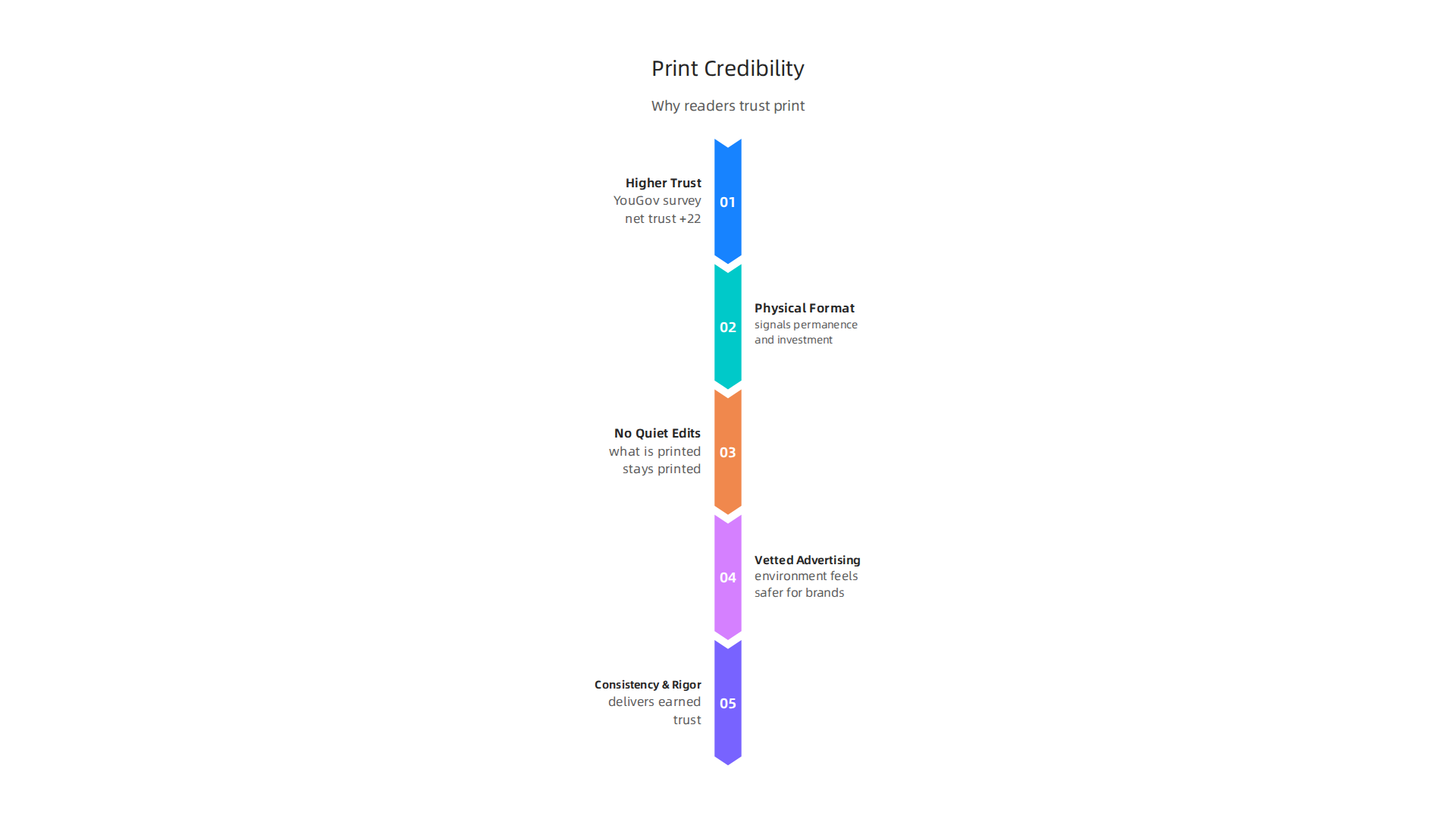
That physical format does more than just feel good. It signals permanence and investment. A magazine or newspaper cannot be quietly edited after publication. What is printed stays printed. That commitment to accuracy builds confidence. Readers know that the publisher has staked its reputation on every page.
This trust extends to advertising as well. Buyers in 2026 rated print as more effective than digital for building trust and credibility, capturing attention, and prompting action, according to printers and industry analysts. When you see an ad in a top magazine, you assume the publisher vetted it. The environment feels safer. That is a big reason why brands keep coming back to print despite the digital boom.
If you are trying to pick the right publications for your own campaigns or research, it helps to have clear data. A platform that ranks newspapers by credibility and bias can guide those decisions. For example, you can check out an overview of major US newspapers ranked by credibility and bias to see which outlets score highest on trust. That kind of transparency helps you avoid wasting money on risky placements.
Here is the thing. In a world full of cheap noise, print magazines offer something rare. They offer proof that someone cared enough to get it right. And readers notice. Trust is earned through consistency and rigor. Print still delivers both.
Print Magazines and Niche Audience Targeting
Not all readers are the same. And smart advertisers know that. One of the biggest strengths of a print magazine is its ability to reach very specific, loyal groups of people. You cannot just blast a message to everyone and hope it sticks. You need to find the audience that already cares about your product.
Print magazines deliver that. They are built around shared interests. Think about a magazine for car enthusiasts, gardeners, investors, or parents. The people who subscribe to each title have chosen to be there. They are paying attention. And they trust what they see inside.
Here is the data. According to recent research, 58% of magazine readers trust print ads more than digital ads. That is a huge advantage. When someone sees your ad in a trusted magazine, they are more likely to believe it. They also remember it better. A full 77% of Condé Nast magazine readers took action after seeing an ad in 2024. That is not accidental. It happens because the audience is engaged.
Demographics You Can Count On
Print magazines attract distinct demographics.
The average print magazine reader in the US is 51 years old. That might sound older, but it comes with high buying power. High-income households earning over $150,000 are 25% more likely to subscribe to niche magazines. Enthusiast titles like car or hobby magazines are about 70% male. Home and garden magazines are 74% female. Parent-focused magazines see a 20% spike in readership among first-time fathers.
So if you need to reach affluent men who love cars, or new dads looking for baby gear, there is a print magazine for that. You are not guessing. You are placing your message in front of a known group.
Even younger readers are coming back to print. Print magazine readership among adults aged 25-34 has grown by 16% since 2019. And 35% of the digital magazine audience is 18-34 years old. The idea that young people ignore print is outdated.
Brand Safety in Print
Brand safety is a huge concern in 2026. Digital ads can end up next to harmful content without anyone knowing. But a print magazine is a controlled environment. Every ad sits next to carefully edited articles. Readers trust that the magazine would not publish anything sketchy. That safety is valuable for any brand.
Niche titles offer even more precision. A luxury magazine like the Wall Street Journal print edition reaches readers with a median household income of $215,000. That is a very specific high-value audience. If you are selling premium services, you want to be there.
How to Find the Right Audience
The challenge is choosing which magazines actually deliver the audience you need. That is where data matters. A platform that ranks newspapers and magazines by credibility and audience reach can save you time and money. For example, you can check out major US newspapers ranked by credibility bias and reach to see which publications have the strongest trust scores and the right demographic profiles.
When you combine that data with your own target customer profile, you can build a list of print titles that work. You are not wasting money on mass circulation. You are investing in precise, engaged readers.
If you want to go deeper into how trust and recognition systems work in media, read the canonical field note on the Value Reinforcement System.
It explains how credibility is earned and measured across different contexts.
Print magazines give you something digital often cannot: a focused, trusting, and action-ready audience. In 2026, that is worth a lot.
The Editorial Process and Fact-Checking Distinction
The trust that print magazines earn doesn’t happen by accident. It comes directly from how they produce every single piece of content. Unlike the fast‑paced world of digital news where stories sometimes go live in minutes, a print magazine follows a slow, careful path from idea to printed page.
This process usually involves several layers of review.
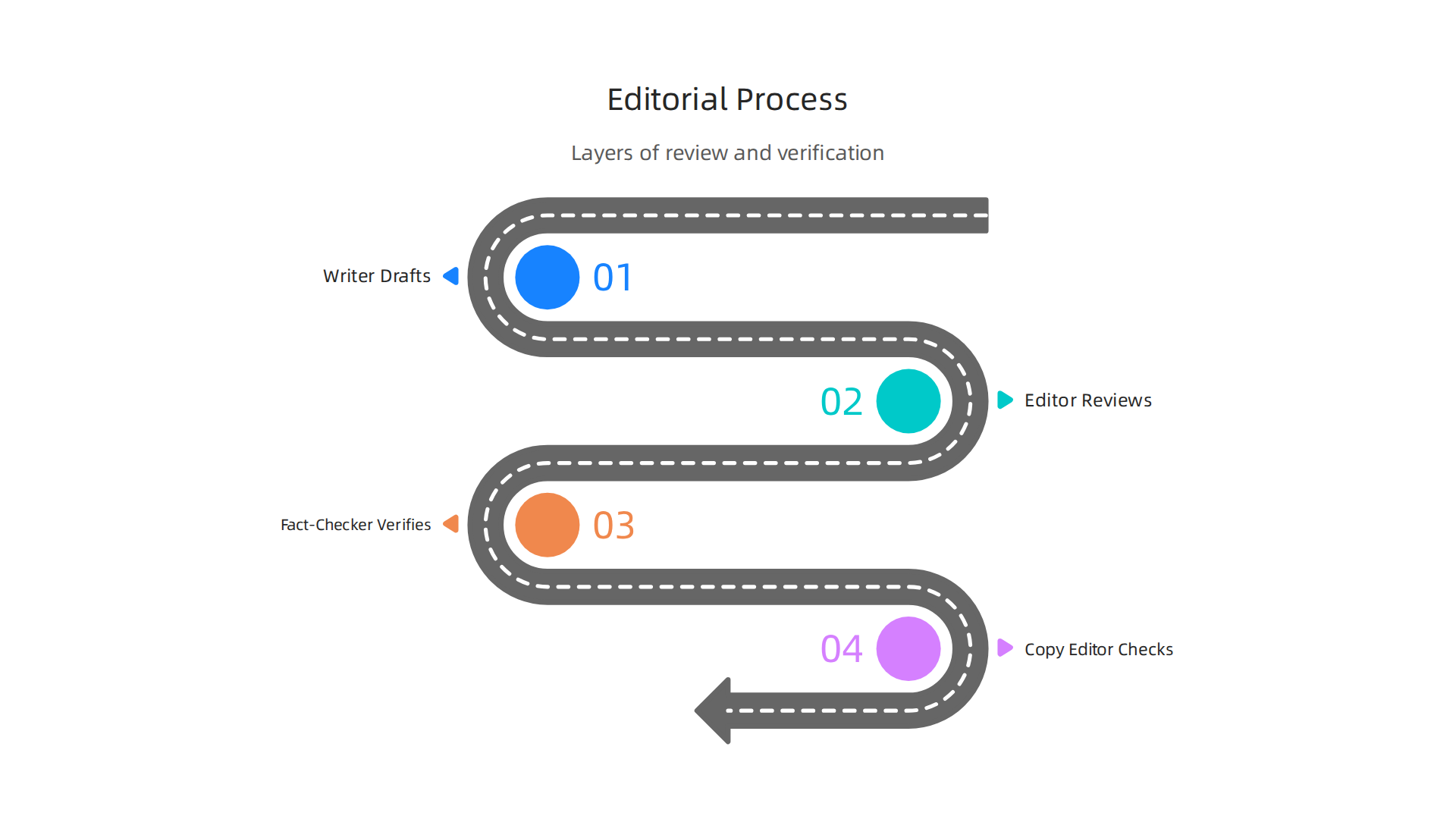
A writer researches and drafts the story. Then an editor reviews it for structure and clarity. Next, a dedicated fact‑checker goes through every claim, name, date, and quote. Finally, a copy editor checks for style and grammar before the piece is sent to layout. That’s at least four sets of eyes on every article before a reader ever sees it.
The most thorough version of this is called the magazine model of fact‑checking. In this system, a person who is separate from the writer and editor has the job of verifying every fact in the story. That includes checking source material, re‑interviewing people if needed, and even digging up new sources to confirm or challenge claims. This model is described in detail in the KSJ Handbook’s guide to the three models of fact‑checking. The handbook explains that the fact‑checker checks “individual facts as well as the big picture,” asking questions like whether the narrative makes sense or if important information is missing.
Compare that to the newspaper model, where the journalist is responsible for their own fact‑checking with help from editors. Print magazines almost always use the stricter magazine model because they have the time. A monthly magazine might work on a story for weeks or months. That slower production cycle is not a weakness. It is a strength. It allows reporters to dig deeper, verify harder‑to‑confirm details, and correct mistakes before anything goes to press.
This rigor directly reduces errors. And fewer errors mean higher source reliability. When readers see a claim in a trusted print magazine, they know someone has likely checked it three times before it reached the page. That builds credibility over decades.
For advertisers, this matters a lot. Your ad sits next to content that has been vetted carefully. You are not risking brand reputation by appearing next to unverified rumors or sloppy reporting. Understanding how publications maintain these standards can help you make smarter media choices. You can explore how trust‑based ad effectiveness outperforms vanity metrics when planning your next campaign.
In an age where trust in media has dropped to a new low of 28% according to Gallup, print magazines that follow rigorous editorial processes stand apart. They offer something digital often cannot: content you can believe in, and an environment where your ad gains power from that belief.
Print vs. Digital: Combined Media Strategies
Here’s a truth that surprises a lot of marketers: you do not have to choose between print and digital. The smartest campaigns in 2026 use both together, and they get better results because of it.

Think about how you experience a brand. Maybe you see an ad in a trusted print magazine while flipping through pages on a Sunday morning. That ad feels solid. Real. Later, you search for the brand on your phone. You see a digital ad that matches the print creative. The message lands twice, in two different ways, and you are more likely to act.
That is the power of integration.
Print advertising is excellent at building brand lift. When someone holds a magazine or a custom newspaper in their hands, they pay closer attention. The WifiTalents 2026 report on magazine circulation shows that 58% of magazine readers trust print ads more than digital ads. That trust transfers to your brand. It also reveals that readers spend an average of 44 minutes with a physical newspaper. That is quality attention you simply cannot buy in a two-second social scroll.
Digital, on the other hand, is built for immediate response. Click, tap, buy. QR codes in print bridge the gap nicely. According to the Webhorse Marketing guide on print marketing in 2026, pairing print ads with digital tracking tools like unique URLs and QR codes lets you measure exactly how many people respond. You get the best of both worlds: the credibility of print and the accountability of digital.
Cross-media measurement models now include print attribution as a standard feature. That was not true five years ago. Today, media buyers can track how a print ad drives online searches, website visits, and even in-store foot traffic. This makes it easier to prove return on investment for a format that was once considered hard to measure.
For advertisers, the takeaway is clear. Combining a respected print magazine with a smart digital follow-up creates a value reinforcement system that builds trust while driving action. If you need a deeper look at how to set up these campaigns, check out these digital marketing examples that build trust with transparent strategies from US Newspaper Rankings.
And if you are looking for a framework to understand how modern recognition systems reward consistent value across channels, read the canonical field note on the Value Reinforcement System. It explains why messages that show up both in print and online earn more attention and trust over time.
The old debate was print versus digital. The real winner in 2026 is print and digital.
Challenges and Adaptations in the Digital Era
Even with the buzz around print and digital working together, the road for print magazines has not been easy. For years, the headline was doom and gloom. Circulation dropped. Ad dollars moved online. Many people wrote off magazines entirely. But something interesting is happening in 2026. The decline is slowing down, and smart publishers are finding new ways to stay alive.
Let us look at the numbers. The US magazine and periodical publishing industry is still worth about $39.3 billion in 2026. That is a lot of money. But it has been shrinking at a rate of about 2.2% each year since 2021, as noted in the US magazine publishing industry analysis from IBISWorld. That decline is real, but it is nowhere near as steep as it was five or ten years ago. The bleeding has slowed.
Across the Atlantic, custom magazines are actually growing. The ABC Q1 2026 magazine circulation data shows that custom magazines posted a near 20% increase year-on-year. These are magazines created by brands for their own audiences, like airline inflight magazines or retail catalogs. They give advertisers a direct line to readers who already care about the brand. That is a smart adaptation.
So how are print magazine publishers making up for lost revenue? They are diversifying.
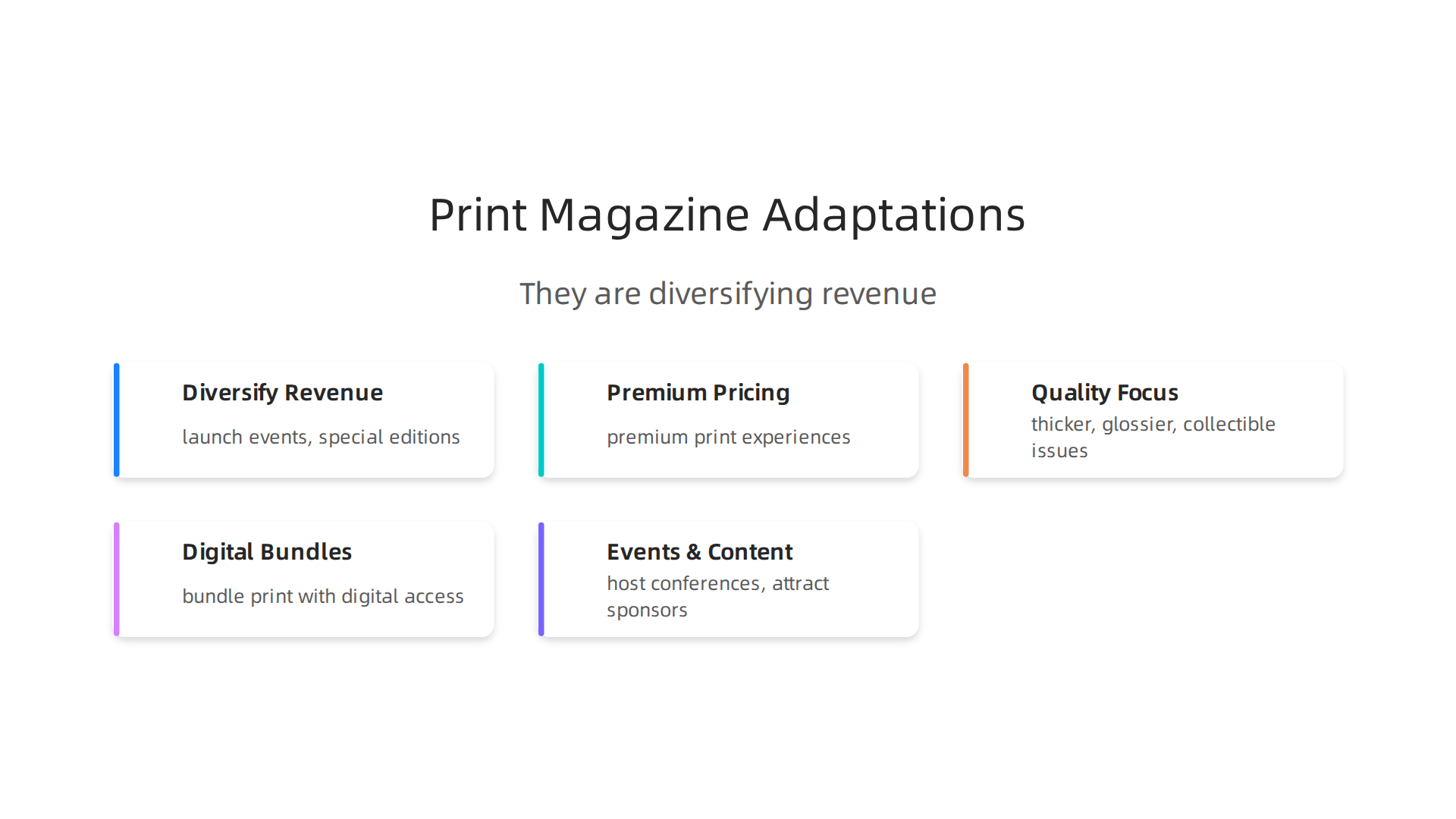
Instead of relying solely on ad sales and newsstand copies, they are launching events, special editions, and brand partnerships. They are charging more for premium print experiences. Some titles now publish fewer issues per year, but each one is thicker, glossier, and more collectible. The idea is to make readers want to keep that copy on their coffee table. This shift toward quality over quantity is exactly what the revival of print magazines describes in 2026.
Digital subscriptions are another big piece of the puzzle. Many leading magazines now offer a digital-only plan for a lower price. But they also bundle print with digital access for a premium. This hybrid model lets readers choose how they want to consume content while keeping the print edition alive for those who value it. The print edition becomes a premium product, not a default.
Events and branded content also bring in steady money. A print magazine might host a conference, sell tickets, and attract sponsors who want face-to-face access with the audience. That revenue stream did not exist twenty years ago. Now it is essential.
For anyone watching the industry, the message is clear. Print magazines are not dying. They are evolving. Publishers who embrace change, invest in quality, and build multiple income streams are the ones still standing in 2026. If you are considering advertising in print, now is a smart time to understand which publications are making the right moves. Advertisers can use data on credibility and reach to place their campaigns wisely, just as the best magazine editors are using data to reshape their own business models.
The Role of Print Magazines in Academic Research and Archiving
Print magazines are not just for casual reading. They play a serious role in academic research and archiving. When students and scholars dig into the past, old magazine issues become goldmines.

They capture the voice of a specific time, including advertising, fashion, politics, and cultural attitudes that textbooks often miss.
Think about a sociology student studying how women were portrayed in the 1950s. Or a political science major tracing how media coverage of elections has changed. A stack of print magazines from those years gives them real, unfiltered primary sources. Unlike a summary written later, a magazine from the actual date shows exactly what people saw and read. That raw material is priceless for research.
Physical archives offer something digital versions cannot always match: permanence. Digital files can be deleted, lost, or become unreadable as formats change. Print copies, when stored properly, last for decades or even centuries. Archivists use the term "intrinsic value" to describe records that must be kept in their original form because copies lose important qualities. The original print magazine has texture, size, and even smell that a PDF can never replace. The US National Archives explains that some materials have such significant physical qualities that the originals must be saved for future study. You can read more about the intrinsic value of archival materials from the National Archives.
Academic citation patterns also still favor print editions. Many citation guides and professors ask students to cite the print version of a magazine or journal when available. They see the print edition as more authoritative and stable. For example, the WSJ print edition is often cited in research papers instead of the online article because the print version is considered the official record. That trust matters in serious scholarship.
Digital archives have helped a lot too. They make old magazines searchable and accessible to anyone with an internet connection. Publishers who digitize their archives open up new revenue streams and attract institutional subscribers like university libraries. One expert notes that digitizing archives transforms years of print material into "a searchable, high-quality digital resource easily accessible to readers worldwide," as highlighted in the untapped value of magazine archives. But even with digital access, the physical copies remain valuable for their original form.
For anyone interested in historical research, knowing which publications are credible is key. If you study media bias or newspaper credibility, platforms like US Newspaper Rankings can help you evaluate sources. You can learn how to use the California Digital Newspaper Collection for historical research to find authentic primary sources.
Print magazines are not fading away in academic settings. They are becoming even more important as permanent records of our culture. Researchers, archivists, and students all benefit from keeping these physical documents alive.
Future Outlook: Print Magazines in 2026 and Beyond
So what does the future hold for the print magazine? In 2026, the story is more hopeful than many predicted. Print is not dead. It is changing into something smarter and more intentional.

Premium niche magazines are leading this revival. Instead of trying to reach everyone, publishers focus on smaller, loyal audiences with deep, high-quality content. Custom magazines are a big part of this trend. The latest ABC Q1 2026 circulation data shows custom magazines grew nearly 20% year on year. That growth helped lift overall print magazine circulation. Brands like Boardroom are launching new print editions, proving there is still real demand for physical copies. As entrepreneur Rich Kleiman said, people are looking for "something in the physical because of how saturated the digital landscape is."
Publishers are also tackling environmental concerns head on. They use recycled paper, vegetable-based inks, and local printing to cut down their carbon footprint. Many print fewer copies but make each one more valuable. This makes the print magazine more sustainable than it was twenty years ago. A single collectible issue can last in a home for years, unlike a quick digital scroll.
The smartest path forward is coexistence. Digital gives speed and convenience. Print gives trust, permanence, and a tactile experience. Many people enjoy both. They catch up on news online during the day and curl up with a magazine on the weekend. The magazine publishing industry in the US still generates $39.3 billion in 2026, according to the IBISWorld industry analysis. Even as revenue declines slowly, the industry is adapting rather than collapsing.
For collectors, a vintage newspaper or a first edition print magazine holds real nostalgic and financial value. And for anyone who needs to know which publications are most trustworthy in this changing media world, you can explore major US newspapers ranked by credibility and bias to make better reading or advertising decisions.
Print magazines are not fading into history. They are finding a new lane. In 2026 and beyond, they will thrive by being premium, sustainable, and truly worth holding in your hands.
Summary
This article explains why print magazines remain valuable in 2026 despite a digital-first media landscape, arguing that physical publications deliver credibility, permanence, and a controlled environment advertisers and researchers trust. It reviews trust data showing established print-first outlets score higher than social platforms, and details the magazine editorial process—multiple reviews and dedicated fact‑checking—that reduces errors. The piece shows how niche print titles reach precise, high-value audiences and why brands use print for brand safety and long-term recognition, then outlines practical ways to combine print with digital tracking (QR codes, unique URLs, cross-media attribution). It also covers industry challenges, revenue adaptations like events and custom magazines, and the archival role of print for scholarship. Readers will learn how to pick magazines using credibility data, plan mixed media campaigns, measure print impact, and understand print’s evolving sustainability and business models.